
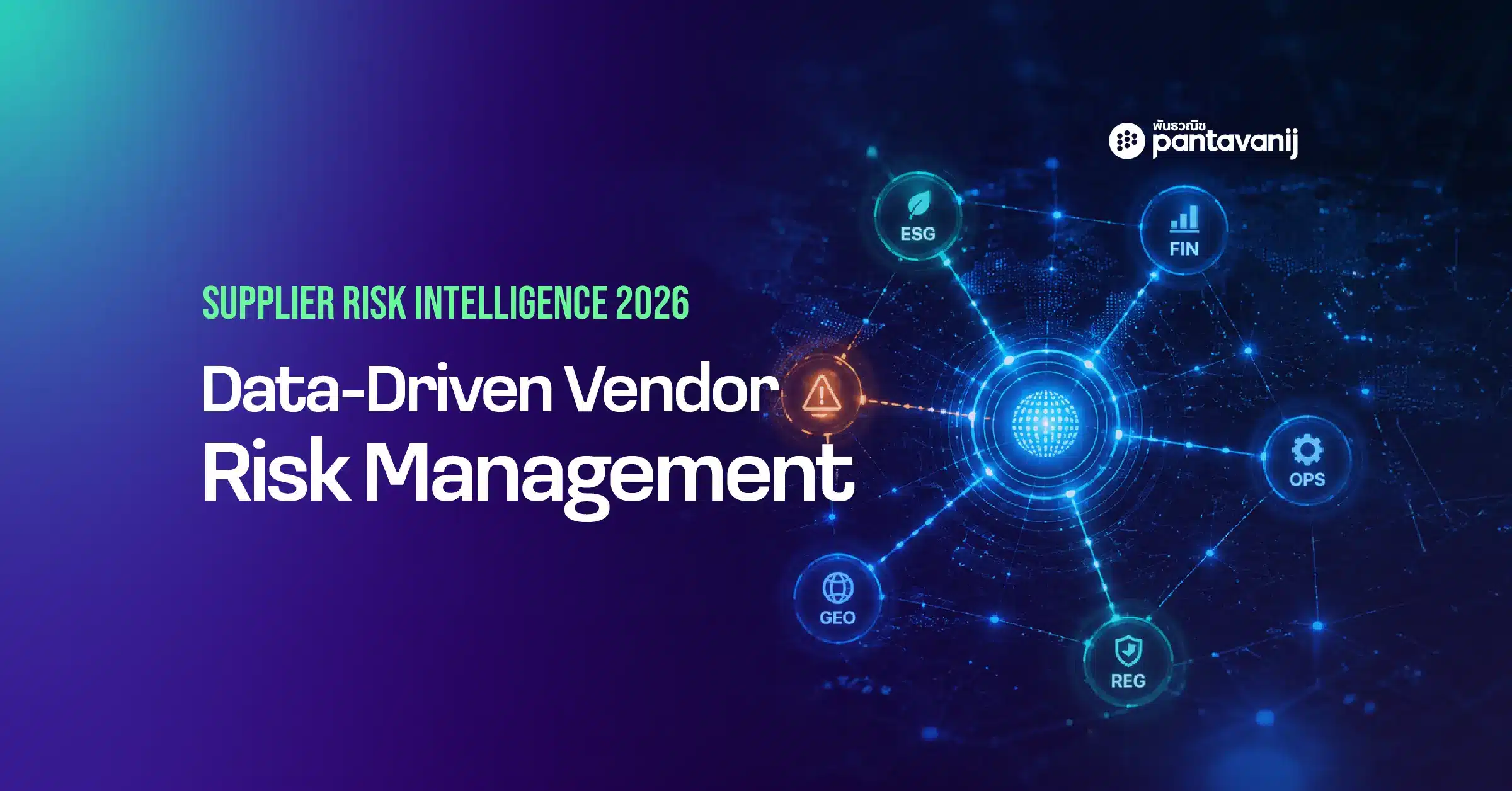
Supplier Risk Intelligence 2026: Moving Beyond Individual Satisfaction to Comprehensive, Data-Driven Vendor Risk Management
Supply chain crises over the past several years — driven by geopolitical conflicts, soaring inflation, and volatile international shipping costs — have irrefutably proven that risks are far too multidimensional to be captured by traditional oversight alone. According to 2026 procurement trend reports, leading organizations worldwide are abandoning outdated vendor evaluation methods that rely on individual satisfaction surveys or surface-level financial snapshots. They are transitioning to a structured, technology-driven framework known as Supplier Risk Intelligence (SRI) — leveraging deep data insights to systematically monitor and analyze supplier risks across every relevant dimension.
Why Traditional Vendor Assessments Have Become a Corporate Blind Spot
For years, procurement teams operated on familiar evaluation pillars: Cost, Quality, and Delivery (CQD) — supplemented more recently by ESG (Environmental, Social, and Governance) standards. While these metrics remain relevant, they are no longer sufficient in a world where supply chains have grown exponentially more complex, interconnected, and exposed to global volatility.
Imagine this: your primary supplier scores excellently on every CQD and ESG metric. Yet hidden beneath those scores are financial instability signals, single-source dependency on a Tier-2 supplier in a politically unstable region, or unresolved labor compliance violations. None of these appear in standard reports — but each one can halt your production line overnight, or worse, permanently damage your brand’s reputation before you even realize what happened.
The Warning Signs Traditional Evaluations Cannot Detect
⚠️ Supply Chain Risks
— How stable are your supplier’s suppliers?
⚠️ Financial Distress Signals
— Debt ratios, cash flow irregularities, bankruptcy precursors
⚠️ Regulatory Compliance Risk
— Labor law violations, environmental breaches, IP disputes
⚠️ Geopolitical Exposure
— Is your supplier located in a high-risk trade zone?
⚠️ Reputational Risk
— Past disputes, negative media coverage, unresolved market complaints
What Is Supplier Risk Intelligence (SRI) and How Does It Work?
Body Text: Supplier Risk Intelligence is a framework and technology system that integrates multi-dimensional data to create a comprehensive, continuously updated picture of every vendor’s risk profile. It goes far beyond the annual scorecard. SRI enables real-time monitoring and predictive analytics that allow procurement teams to detect potential disruptions before they become crises — transforming reactive firefighting into proactive risk governance.
The 5 Core Components of an Effective SRI Framework
- Data Aggregation — Consolidating data from internal and external sources into a single intelligence layer
- Risk Profiling — Building individualized risk profiles for each supplier
- Continuous Monitoring — Tracking early-warning signals across financial, operational, and reputational dimensions
- Predictive Scoring — Calculating forward-looking risk scores based on pattern recognition
- Strategic Decision Support — Translating raw data into actionable sourcing decisions
3 Steps to Achieving Supplier Risk Intelligence with Supplier 360
To effectively navigate modern supply chain risks, procurement teams must embed data-driven technologies into their core workflows. Pantavanij’s Supplier 360 is specifically engineered to address supplier management across three critical dimensions — moving your organization from reactive to predictive risk management.
Step 1 — Objective Performance Evaluation
Replace subjective satisfaction surveys and inconsistent individual opinions with a standardized system that captures and evaluates real operational performance data. Track on-time delivery rates, defect ratios, response times to issues, and contractual compliance — all measured consistently across your entire organization, not just within siloed teams.
Step 2 — Comprehensive 360-Degree Risk Assessment
Knowing your vendor’s surface metrics is no longer enough in 2026. Supplier 360 empowers your team to drill deep into historical records, assess financial health indicators, evaluate regulatory compliance histories, and analyze risk profiles across every relevant dimension for each individual supplier. Prevent hidden problems from surfacing unexpectedly by building systematic visibility into your entire supplier ecosystem.
Step 3 — Centralized Supplier Data for Strategic Sourcing
A persistent challenge in procurement is that critical vendor data lives in disconnected spreadsheets, isolated email threads, or solely in the memory of individual staff members. Building truly effective Supplier Risk Intelligence requires centralizing all supplier information onto a unified platform, giving executives and procurement teams a single source of truth for risk visibility — enabling accurate, confident strategic sourcing decisions at scale.
📌 Explore full Supplier 360 features
Real-World Impact: When Intelligence Prevents Crisis
Consider this scenario: an electronics component manufacturer had relied on the same supplier evaluation system for years. Their primary supplier consistently earned top CQD scores. However, when the company implemented Supplier Risk Intelligence, it discovered that this top-rated supplier sourced 90% of a critical raw material from a single Tier-2 vendor located in a region facing an escalating trade dispute — and was showing early-stage financial stress indicators. This discovery enabled the manufacturer to diversify sourcing and onboard a backup supplier months before any actual supply disruption materialized. That’s the power of intelligence over intuition.
Risk Is Manageable — When Your Data Is Deep and Centralized
In 2026, data is the ultimate strategic currency. Managing supplier risk is no longer exclusively the domain of the audit team — it is the beating heart of strategic procurement, directly determining an organization’s competitive resilience in a volatile global market.
Organizations that invest in robust supplier intelligence technologies like Supplier 360 from Pantavanij build transparent, data-rich procurement ecosystems. They uncover hidden risk insights, make decisions grounded in verified facts, and protect sustainable business growth across any market condition — no matter how unpredictable the world becomes.
💡 Ready to transform how your organization manages supplier risk?
📌 Request a Free Demo of Supplier 360
Frequently Asked Questions About Supplier Risk Intelligence
Q : What is Supplier Risk Intelligence (SRI) and how does it differ from traditional vendor assessment?
A : SRI is a multi-dimensional data-driven framework for continuously analyzing and monitoring vendor risks. Unlike traditional assessments that rely on periodic CQD scorecards or satisfaction surveys, SRI encompasses financial risk, regulatory compliance, geopolitical exposure, reputational signals, and Tier-2 supply chain vulnerabilities — all in real time.
Q : What size of organization benefits most from Supplier Risk Intelligence?
A : SRI is valuable for any organization managing more than 10 suppliers or operating complex supply chains. Whether you’re a growing mid-sized enterprise seeking risk reduction or a large corporation requiring strategic sourcing transparency, Supplier 360 scales to fit your needs.
Q : How does Pantavanij’s Supplier 360 differ from other Supplier Management systems?
A : Supplier 360 is purpose-built for the ASEAN business landscape, combining Performance Evaluation, Risk Assessment, and Supplier Data Management in one integrated platform — with dedicated Thai-language support and regional compliance frameworks built in.
Q : How long does it take to implement Supplier Risk Intelligence?
A : Implementation timelines vary by organization size and supplier count. Generally, Supplier 360 can be fully onboarded within 4–8 weeks, supported by a dedicated implementation team throughout the process.
Q : Can SRI genuinely reduce organizational costs?
A : Absolutely. Early risk detection prevents the far greater costs of emergency production halts, last-minute supplier replacement, expedited logistics, and brand reputation damage. The ROI on SRI investment typically materializes faster than most organizations expect.
Sources: Inspired by and adapted from e-procurement.com and penny.co