
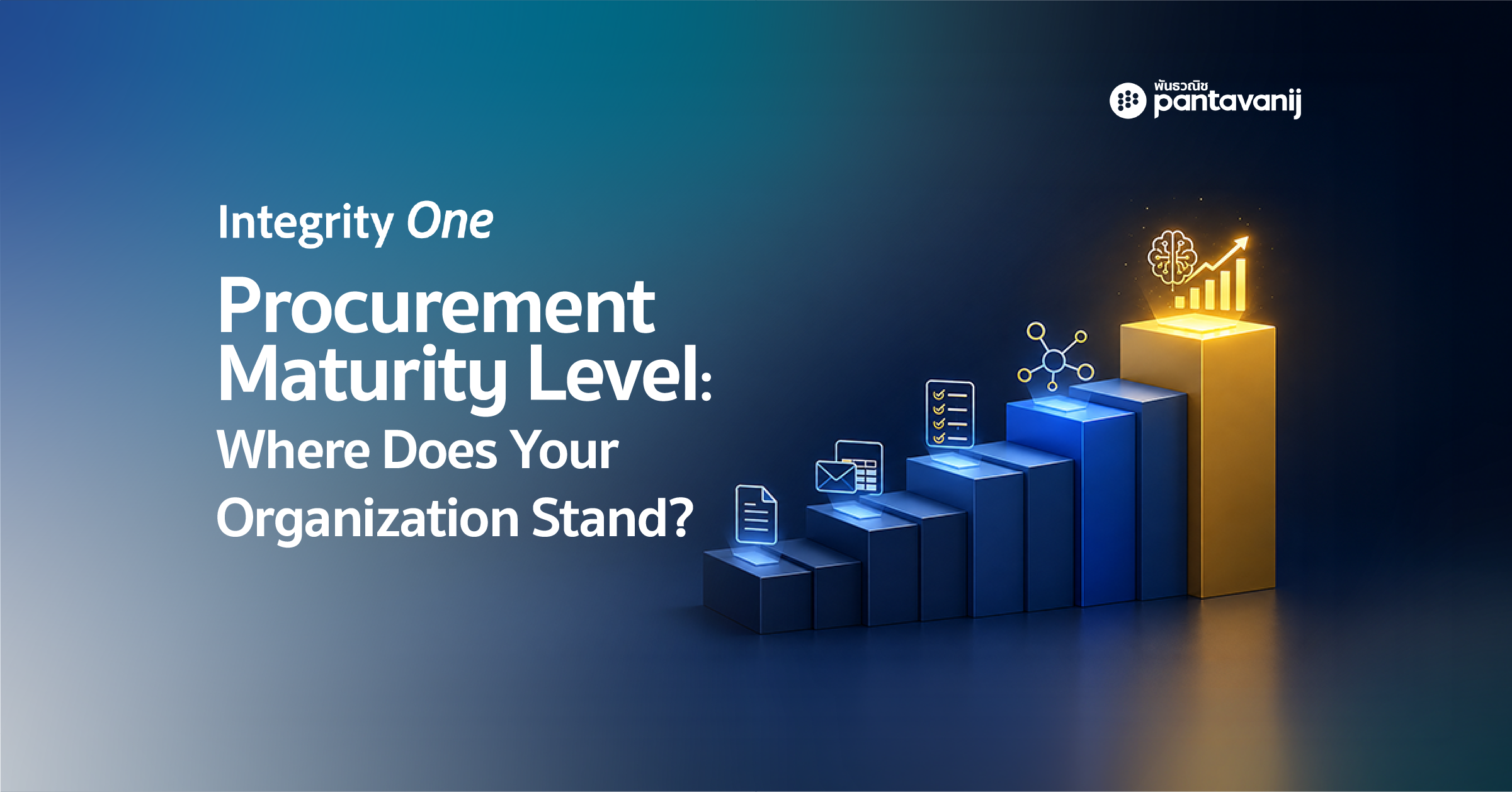
Procurement Maturity Level: Where Does Your Organization Stand?: A Practical 5-Level Procurement Maturity Framework
Many organizations invest in digital procurement systems without knowing their actual “Procurement Maturity Level,” leading them to choose technology that is unsuited to their true state. While some organizations still rely on Excel and email for approvals, others are already utilizing AI for spend analysis. Ultimately, not knowing where you stand is a risk that can make your technology investments a total waste.
In this article (updated for 2026), Pantavanij invites you to explore a practical 5-level procurement maturity model to assess your organization, complete with a quick self-assessment checklist and actionable steps to level up. If you are preparing to request a budget for Digital Procurement or searching for answers to “Why past Transformation projects failed,” this article will help answer those questions.
Why the Procurement Maturity Model Matters
- Investing in the Wrong Technology: Organizations that jump straight to advanced AI systems often fail to maximize ROI because foundational data was not prepared first.
- Setting Unrealistic Goals: Creates unnecessary pressure on teams and leads to missed KPIs.
- Misaligned Executive Communication: Inability to articulate what the organization should invest in first versus later.
- Falling Behind Competitors: Competitors who know their current standing can plan targeted improvements faster and more efficiently.
- Unclear Roadmap: The procurement team doesn’t know what the “next step” is, leading to inconsistent development plans.
Key Concepts to Know First
What Is a Procurement Maturity Model?
A framework that categorizes the development of the procurement function into stages, from fully manual operations to data-driven strategic procurement. It helps organizations “see themselves clearly” before investing in or changing any process.
Assessment Dimensions
- Process — How standardized are workflows?
- Technology — Digital tools vs. manual methods
- People — Skills and roles within the team
- Data & Analytics — Ability to use data for decisions
- Governance — Clarity of policy and controls
Why Assess All 5 Dimensions, Not Just Technology
Many organizations mistakenly believe maturity is only about “having digital tools.” In reality, an organization might own expensive digital systems while its people still lack the right skills, or governance remains unclear — leaving overall maturity low. Assessing all 5 dimensions gives a far more accurate picture.
@pantavanij 🪜 องค์กรคุณอยู่ระดับไหนใน Procurement Maturity? ก่อนลงทุนในเทคโนโลยีจัดซื้อ ต้องรู้ก่อนว่าองค์กร “พร้อมแค่ไหน” มาดู 5 ระดับของ Procurement Maturity Model พร้อม Checklist ที่ช่วยประเมินองค์กรของคุณได้จริง 📌 อยากรู้ว่าองค์กรอยู่ระดับไหน? อ่านบทความเต็มได้ที่ลิงก์ในคอมเม้นต์ #Procurement #ProcurementMaturity #DigitalProcurement #DigitalTransformation #Pantavanij #eRFX
The 5 Levels of Procurement Maturity
|
Level |
Name |
Key Characteristics |
| Level 1 | Reactive | Fully manual operations. Purchases happen only when urgently needed, with no standardized process. |
| Level 2 | Managed | Basic policies exist, but the team still relies heavily on spreadsheets and email. Data remains fragmented. |
| Level 3 | Defined | Standardized processes are in place, with partial adoption of digital tools such as e-sourcing or e-approval. |
| Level 4 | Integrated | Procurement systems connect with ERP and other departments, with real-time dashboards for tracking. |
| Level 5 | Optimized | Data analytics and AI drive strategic decisions. Procurement becomes a true strategic partner delivering measurable value. |
💡 Tip: Most organizations aren’t at the same level across every dimension — for example, Technology might sit at Level 3 while Governance lags at Level 2. That’s normal. Focus improvement efforts on the weakest dimension first, since it typically acts as the overall bottleneck.
Quick Self-Assessment Checklist
Ask your procurement team these questions for a rough estimate of where you stand:
- Are most purchases driven by urgent need, or planned in advance? (Reactive vs Managed)
- Is procurement data stored in spreadsheets/email, or in a searchable central system? (Managed vs Defined)
- Are e-sourcing or e-approval tools actually in use? (Defined vs Integrated)
- Does your procurement system connect with ERP and other departments in real time? (Integrated vs Optimized)
- Does your team already use data analytics or AI for strategic decisions? (Optimized)
The more “yes” answers to the later questions, the higher your organization’s maturity level.
Best Practices for Advancing Maturity
- Conduct an honest self-assessment — before investing in any technology.
- Progress step by step — skipping levels often means the data or process foundation isn’t ready.
- Invest in governance alongside technology — for sustainable adoption.
- Benchmark against industry peers — to understand relative positioning.
- Assign clear roadmap ownership — so progress doesn’t stall when team members change.
Common Mistakes When Trying to Advance Maturity
- Purchasing advanced technology (e.g., AI analytics) before foundational data is clean enough to use
- Focusing only on technology without developing people and governance in parallel
- Not measuring whether each investment actually moved the maturity needle
- Expecting to jump 2-3 levels within a single year, which rarely matches organizational readiness
How Digital Procurement Accelerates Maturity
Digital procurement is a key accelerator that helps organizations move from Level 2-3 to Level 4-5 faster by:
- Standardizing processes automatically, reducing manual errors
- Capturing the data required for deeper, higher-level analysis
- Embedding governance into every procurement transaction automatically
- Reducing the time spent “cleaning data” before analysis — often the biggest bottleneck to reaching Level 5
How Pantavanij Supports This Journey
- eRFX helps organizations still at the Reactive or Managed stage establish standardized procurement processes immediately, reducing dependency on email and spreadsheets.
- Integrity One strengthens governance and transparency — a critical foundation for advancing to Level 4-5.
Learn more about the eRFX Solution
Learn more about Integrity One
The Pantavanij team offers a free procurement maturity assessment along with a tailored roadmap for your organization.
Frequently Asked Questions
Q1 : What maturity level are most Thai organizations at?
A : Based on consulting experience, most Thai organizations fall between Level 2-3 — basic standards exist, but full integration is lacking.
Q2 : How long does it take to move up one maturity level?
A : On average, organizations take 6-18 months to progress one level, depending on size and data readiness.
Q3 : Is it necessary to go through every level?
A : Yes, levels should be progressed sequentially, as each stage forms the foundation for the next. Skipping levels often leads to underwhelming technology ROI.
Q4 : How can I start assessing my organization’s maturity?
A : Start by evaluating the 5 dimensions (Process, Technology, People, Data, Governance) against the level descriptions in this article, or consult an expert.
Q5 : Does a small organization need to reach Level 5?
A : Not necessarily. The right target level depends on your business size and supply chain complexity — a smaller organization may get the most value from stopping at Level 3-4.
Q6 : If each dimension sits at a different level, which one represents my organization overall?
A : Use your weakest dimension as the starting point for improvement, since the laggard dimension is usually the bottleneck holding back overall performance.
Understanding your organization’s procurement maturity level is the starting point for precise, effective planning
whether choosing technology, developing your team, or building governance aligned with your actual current state. The more accurately you assess where you stand, the more value you’ll get from every step forward.
If you’d like to find out what level your organization is at, or want a roadmap tailored to your business, the Pantavanij team is happy to offer a free consultation.