
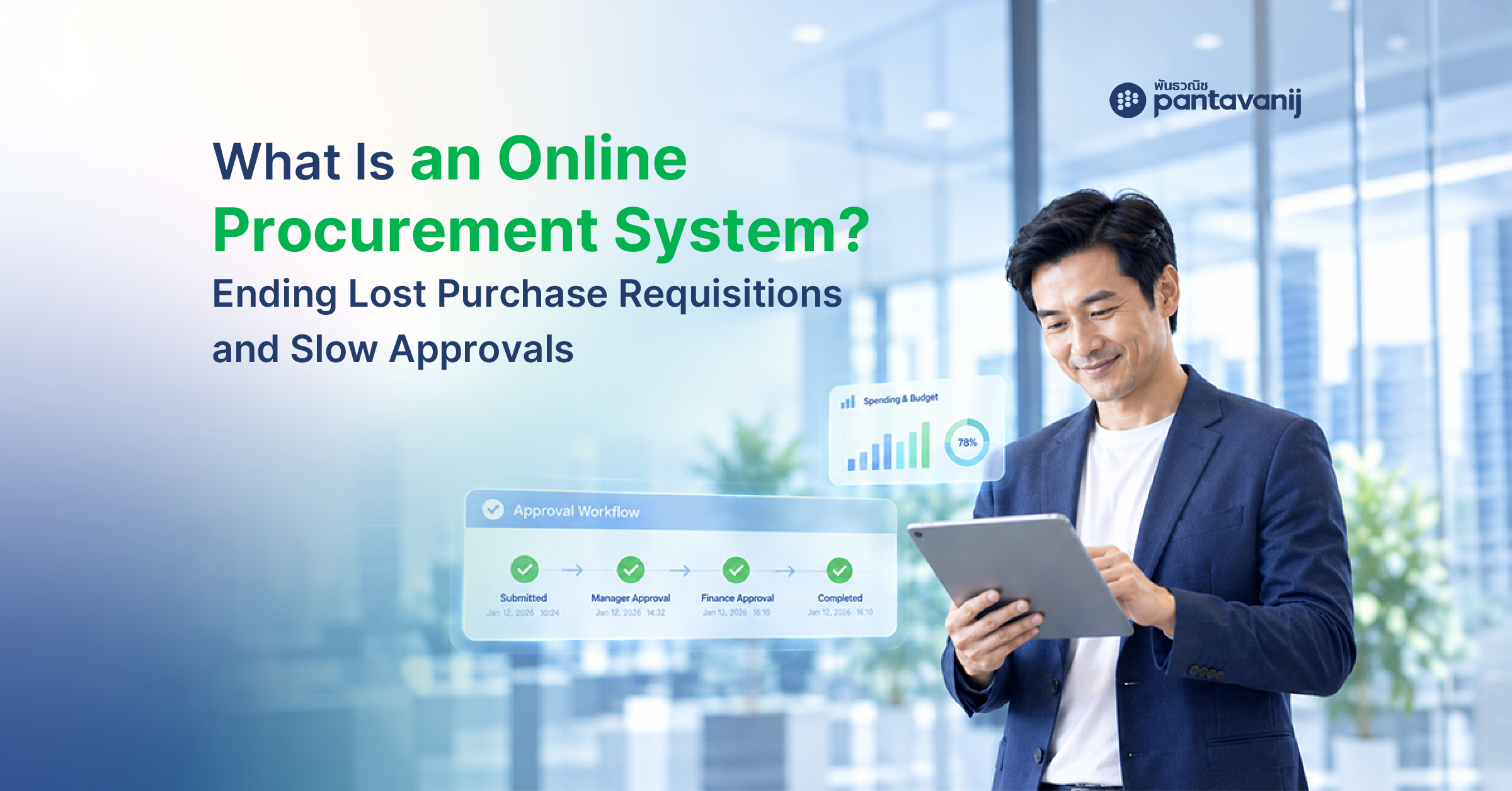
What Is an Online Procurement System? Ending Lost Purchase Requisitions and Slow Approvals
Lost purchase requisitions. Approvals that sit for weeks. A procurement budget with no overall visibility. These problems can all be solved with a single system. Let’s look at what an online procurement system is and how it can help your organization.
Why Purchase Requisitions Keep Getting Lost, and Approvals Keep Dragging On
Many organizations’ procurement teams still work primarily through paper documents, Excel files, and email. When an employee needs to purchase something, the process starts with filling out a purchase requisition (PR), which is then routed for sign-off up the chain of command. The same problems keep recurring: requisitions go missing along the way, original documents can’t be found when an executive is traveling, and waiting on physical signatures delays approval by days. Executives, meanwhile, have no real-time view of overall procurement spend, making strategic decisions difficult. Online procurement systems were built to solve exactly these problems by moving the entire process onto a digital platform where every step can be tracked.
What Is an Online Procurement System?
An online procurement system (e-procurement) is a platform that consolidates an organization’s entire procurement process into a single digital system — from the purchase requisition, through hierarchical approvals, to issuing the purchase order (PO), and on to vendor data management. It replaces document routing and wet-ink signatures with a digital approval process that can be completed from anywhere and audited at every step.
See more information on online e-procurement systems here.
How an Online Procurement System Works
The process begins when an employee creates a purchase requisition in the system. The request then enters an approval workflow, with a hierarchy predefined by spending limit or product category. Once fully approved, the system automatically issues a purchase order to the vendor and tracks status in real time through to delivery. This entire process is collectively known as procure-to-pay (P2P). Some newer-generation platforms are starting to add AI approval and smart matching to this process, automatically matching line items across the purchase requisition, purchase order, and delivery note, and suggesting the appropriate approval path based on historical spending patterns — further reducing the burden of manual verification.
Benefits of an Online Procurement System for Your Organization
- Cuts approval time from several days down to a few hours, since there’s no need to wait on physical signatures
- Reduces errors from duplicate data entry or lost documents
- Provides an audit trail showing who approved what, and when
- Enables more accurate budget control through centralized data
- Improves vendor price negotiation using order history and previously agreed pricing
The Hidden Costs of Traditional Procurement — and What an Online Procurement System Actually Fixes
The costs of a traditional procurement process rarely show up directly on the financial statements, but the damage accumulates. Time procurement staff spend chasing documents and signatures is time that should be spent negotiating with suppliers. Without a standard for pre-agreed pricing, different departments may end up buying the same product at different prices. And without a system for auditing past activity, an organization risks duplicate purchases or overspending without realizing it. An online procurement system solves this by centralizing all data in one place and requiring every purchase order to go through an auditable approval process.
Key Features an Online Procurement System Should Have
- A digital purchase requisition system that can be filled out and tracked from any device
- An online purchase order (PO Online) system that generates documents and notifies vendors automatically
- An approval workflow that can be adapted to fit the organization’s structure
- A vendor management system for storing vendor records and purchase history
- Integration with existing accounting or ERP (Enterprise Resource Planning) systems, along with a spend-analysis dashboard
Vendor Management with a Vendor Management System
A vendor management system consolidates vendor history, previously agreed pricing, and delivery quality evaluations in one place, reducing the time needed to compare new vendors and allowing procurement teams to choose partners based on real data.
What Type of Organization Is an Online Procurement System Best Suited For?
Best suited for organizations with multiple departments and cross-functional purchase approvals, a monthly volume of purchase orders too high for paper-based tracking to keep up, a need for an audit trail to support ISO (International Organization for Standardization) compliance, or businesses growing fast enough that their existing process can no longer keep pace.
What to Consider Before Choosing an Online Procurement System
Consider the system’s ability to adapt its workflow to your organization’s structure, its integration with your existing accounting or ERP system, its pricing model (per-user license vs. subscription), data security, and after-sales service including staff training.
Frequently Asked Questions About Online Procurement Systems
Answers to common questions people have before deciding to adopt an online procurement system, to help you feel more confident before getting started.
How Is e-Procurement Different from a General Online Procurement System?
E-procurement is simply the international term used to refer to the same concept as an online procurement system; the two terms are used interchangeably in a private-sector context.
How Does an Online Procurement System Differ from Government Procurement Systems?
This article refers to systems for private organizations. Government procurement uses the e-GP (Electronic Government Procurement) system operated by the Comptroller General’s Department, which follows its own legal regulations for public-sector procurement. The user groups and rules involved are entirely different.