
The Role of AI Across the Procurement Process
AI in eProcurement is the use of artificial intelligence together with electronic procurement systems to analyze data, reduce repetitive work, detect anomalies and support decision-making, from procurement planning and supplier search and selection through to follow-up and post-purchase risk management.
In many organizations, procurement data is still scattered across emails, Excel files, quotation documents and accounting systems. Gathering that data to compare, approve or audit after the fact takes time and can lead to errors caused by duplicated or incomplete information.
An eProcurement system connects data and procurement steps in a digital workflow, while AI analyzes that data, finds patterns and prepares information to support decisions. This reduces repetitive workload and gives procurement teams more room to focus on strategy, negotiation and supplier management. Final decisions remain under the review of the responsible people.
What Is AI in eProcurement?
AI in eProcurement is the application of Artificial Intelligence in electronic procurement processes, from spend analysis, demand forecasting, supplier search and evaluation, and proposal analysis, to monitoring performance and post-purchase risk.
How Do AI, Generative AI and Automation Differ?
| Technology | Main function |
Procurement examples |
| Automation | Works according to rules and steps defined in advance | Routing documents into approval lines, sending status alerts, or creating a purchase order once conditions are met |
| AI | Analyzes data, learns patterns, forecasts or ranks information | Categorizing spend, assessing risk, or finding transactions with unusual patterns |
| Generative AI | Creates or summarizes new content from prompts and data | Summarizing proposals, drafting RFP questions, explaining report data, or summarizing key contract points |
Automation is therefore not always AI. For example, routing a purchase request to an approver based on its value is a predefined rule. AI, by contrast, can analyze patterns in data to help forecast or make recommendations, while Generative AI is a branch of AI focused on creating content such as text, summaries or answers in natural language.
Understanding this distinction helps organizations choose technology that fits the problem. Some tasks can be solved with workflow automation alone, while tasks involving large volumes of data or complex patterns may be better suited to AI.
How Does AI in eProcurement Differ from a Conventional eProcurement System?
A conventional eProcurement system plays an important role in digitizing procurement steps, standardizing work and keeping data in one system. AI-enabled eProcurement goes further by using that data to analyze, find patterns and help prepare information for decisions.
| Aspect | Conventional eProcurement |
AI-enabled eProcurement |
| Operation | Follows defined workflows and conditions | Analyzes data and provides information to support decisions |
| Reporting | Shows data and past performance | Helps identify trends, forecast, or flag issues worth reviewing |
| Auditing | Checks against set rules, limits or conditions | Helps find unusual patterns that fixed rules may miss |
| Information search | Uses menus, filters or predefined reports | May search and summarize data through natural-language questions |
| Proposal comparison | Users collect and compare data themselves | AI helps extract, summarize and structure data before users review it |
| User role | Performs and checks each step | Reviews the analysis, applies judgment and makes the final decision |
AI in eProcurement Creates Value in 3 Main Areas
- Reduces time spent collecting, checking and structuring data
- Frees procurement teams for strategy, negotiation and supplier management
- Adds information to support decisions and highlights issues worth reviewing
Actual capabilities vary by system, depending on the data, the technology and the provider’s design. Organizations should therefore consider the use case they want to solve, not just the word “AI.”
How Does AI Support eProcurement Across the Whole Process?
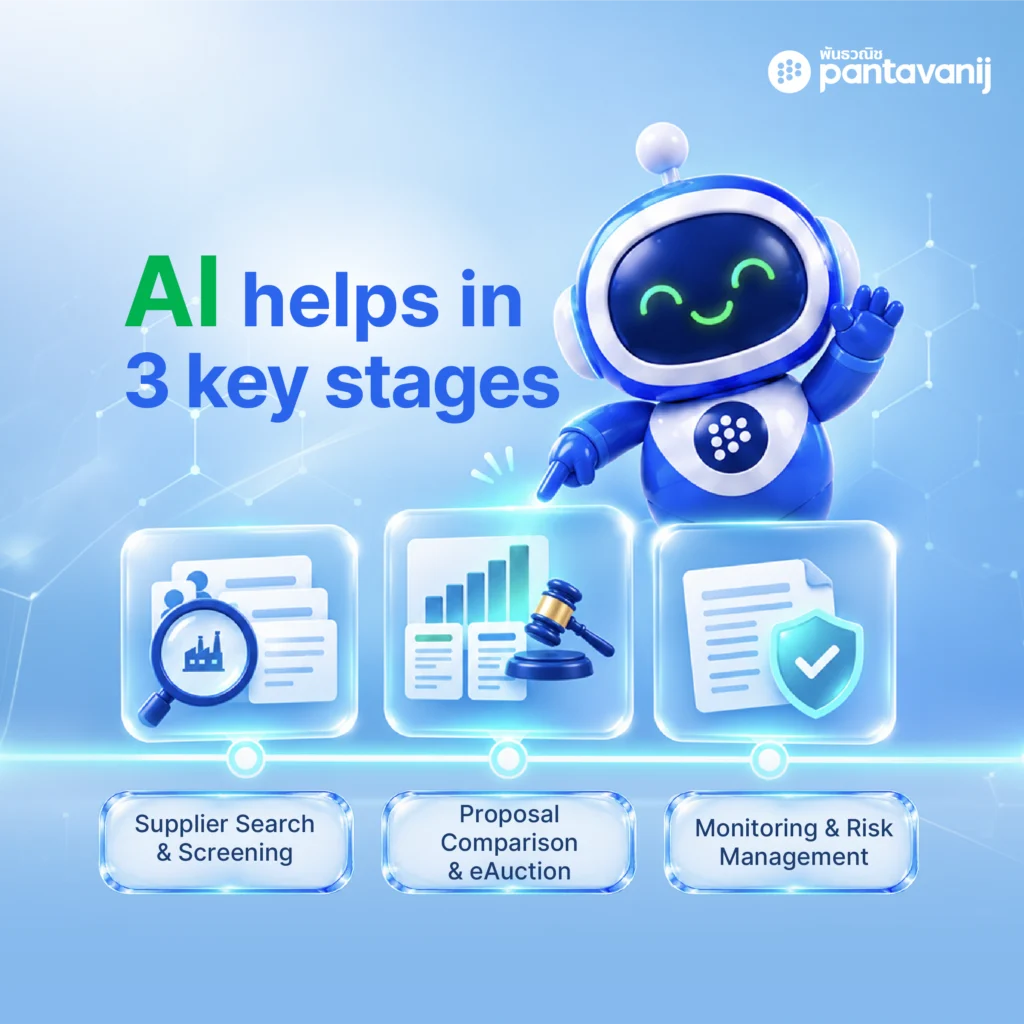
Looking at use cases by stage of the process helps organizations see where AI and digital systems create value. The process can be divided into three main stages: pre-purchase, during purchase and post-purchase.
| Process stage | Work supported by technology |
Related Pantavanij solutions |
| Pre-purchase | Prepare requirements, search, verify and invite suppliers | eRFX, Supplier360, Supplier Connect |
| During purchase | Receive and compare proposals, run auctions, detect anomalies | eRFX, eAuction, Integrity One |
| Post-purchase | Manage PR–PO–Invoice, monitor suppliers, review risk | eProcurement, Supplier360, Integrity One |
This table shows how the process connects to the related solutions. It does not mean every function in each solution uses AI. Some steps run on workflow and automation, while AI suits the parts that involve analyzing data, finding patterns or flagging issues worth reviewing.
Pre-Purchase: How Does AI Help with Planning and Finding Suppliers?
The pre-purchase stage is the starting point that defines the budget, scope of work, selection criteria and the group of suppliers who will take part. If the starting data is incomplete or unstructured, problems tend to carry over into the comparison and approval steps.
- Analyze data to prepare for procurement
Past procurement data, such as product categories, purchase orders, prices and user departments, can be analyzed to help the organization see spending patterns and prepare better procurement plans.
At Pantavanij, the eProcurement system supports recording and retrieving data across the process, from sourcing and purchasing to goods receipt and invoicing. Structured data is therefore an important foundation for analysis and for future AI development.
- Search and screen suppliers
AI for Procurement can help group or screen supplier data by defined factors such as product category, service area, qualifications, certifications or work history, giving procurement an initial shortlist to consider.
In Pantavanij’s system, procurement teams can use eRFX to search suppliers from the database, create questionnaires, invite suppliers to quote and collect information in a central system. Supplier360 is used to verify supplier qualifications and assess their business. Using both together means sourcing considers not only price but also qualification and risk information.
- Check data and initial risks
Before inviting suppliers into the process, organizations should check whether key information is complete and up to date, such as company information, supporting documents, qualification against criteria and past evaluation results.
Pantavanij’s Supplier360 acts as a central hub for verifying qualifications and supplier evaluation results. Supplier Connect lets suppliers manage their company profile, offer product information, join eRFX or eAuction, and accept purchase orders online. Standardized data reduces repeated document collection and lets buyers and suppliers work from the same set of information.
- Help prepare RFI, RFP and RFQ
Generative AI can help structure documents, draft questions and summarize initial requirements from the information users provide, for example turning a Scope of Work into a list of RFP questions or summarizing the requirements suppliers must answer in an RFQ.
For execution, Pantavanij’s eRFX supports creating lists of goods and services, preparing questionnaires, inviting suppliers to quote and comparing responses in one system.
During Purchase: How Does AI Support Analysis and Decision-Making?
When the process reaches receiving proposals, comparing and negotiating, the volume of documents and variables grows quickly. AI can help structure data so procurement teams see key issues more easily, but decisions should follow criteria set by the organization and be explainable afterward.
- Check proposal completeness
The system can check whether suppliers have submitted everything required, such as price, delivery time, payment terms and supporting documents. Where AI is added, it can help extract and summarize data from documents so users can review faster.
With Pantavanij’s eRFX, suppliers can submit quotations and answers online, while procurement can track status and collect supplier data in one system.
- Compare prices and terms
The lowest bid may not deliver the best total cost or value. A system should therefore help arrange data in one structure so price, quality, delivery time, payment terms, after-sales service and other relevant factors can be compared.
Pantavanij’s eRFX automatically compares prices and questionnaire answers and displays comparison data in charts, helping procurement see the differences between proposals more easily.
- Example use case: Supplier A offers a lower unit price but has a longer delivery time and requires faster payment. Supplier B is slightly more expensive but delivers sooner and offers a longer credit term. The system can gather the differences, while Procurement, Supply Chain and Finance jointly assess the business impact before deciding.
- Support negotiation with eAuction
When goods and services have clear specifications, organizations may use eAuction to let suppliers compete by bidding within a set time. The system records price movements and makes the process auditable afterward.
Pantavanij supports both single-variable auctions, which focus on price competition, and multi-variable auctions that consider more than one factor using a Price per Performance concept. The auction method should match the type of goods or services and the criteria the organization values.
- Detect unusual procurement patterns
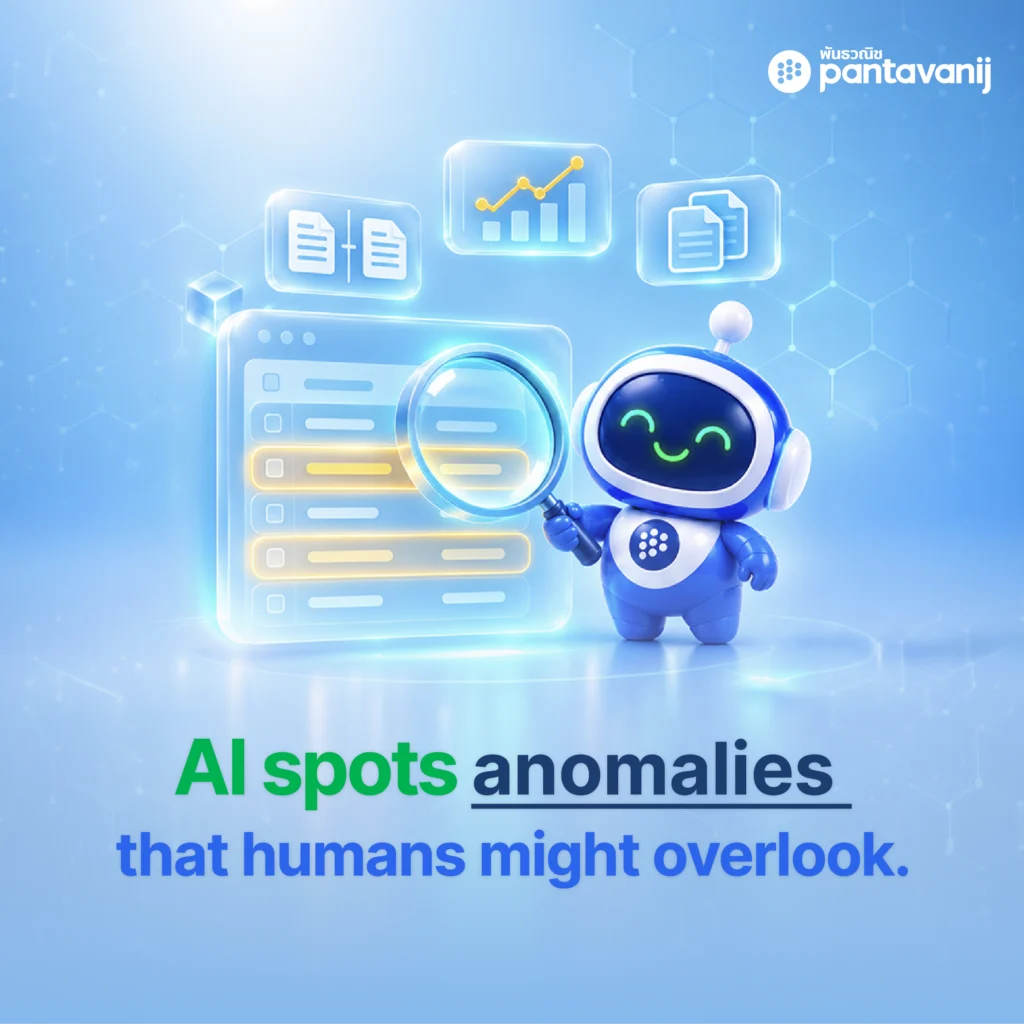
In procurement with many transactions, some anomalies are hard to spot by reviewing documents one by one. AI can analyze data across many transactions to find patterns or connections that deserve further review.
Examples of risk patterns that may be detected:
- Split purchases or Split PO: Dividing a purchase into several items so each amount stays below the approval limit.
- Prices that differ from the norm: Goods or services of the same type priced noticeably higher than purchase history or comparable items.
- Employee–supplier connections: Related details, such as surnames, addresses or contact information, that should be checked further.
- Repeated transaction patterns: Purchases, suppliers or transaction timings that repeat in ways that differ from typical behavior.
Pantavanij’s Integrity One uses AI to support detection and risk assessment in procurement, helping gather relevant data, create and prioritize cases and track review status under the organization’s defined process.
However, an AI alert is only a signal that an item should be reviewed, not a conclusion that any person or supplier has committed fraud. Responsible staff must still examine the evidence, procurement conditions and context of each case before taking further action.
- Support decisions and approvals
Data from eRFX, eAuction, Supplier360 and risk reviews can be combined so stakeholders see price, supplier qualifications, commercial terms and issues to check before approval.
Expert Insight: AI should act as a decision-support tool, not a decision-maker, especially for supplier selection, budget approval and decisions that affect risk or business relationships. Organizations should always designate who is responsible for reviewing results and giving final approval.
Post-Purchase: How Does AI Help with Follow-Up and Risk Management?
Procurement does not end when a supplier is selected. It also covers creating purchase requests, issuing purchase orders, receiving goods, invoicing, payment and post-delivery evaluation.
- Connect PR, PO, goods receipt and invoice steps
Pantavanij’s EP One is an end-to-end procurement platform that connects the process from creating purchase requisitions and approvals to issuing purchase orders, receiving goods and verifying invoices. AI helps analyze and convert PR data into POs automatically, reducing re-entry and keeping data continuous between steps.
The system also supports a Workflow Builder for designing approval lines that match the organization’s approval authority, along with eInvoice Matching, which detects and matches data between the purchase order (PO), goods receipt (GR) and invoice before they enter the financial process.
Connecting this data makes it easier for Procurement and Finance to check document consistency, track status and find items that need further review.
- Monitor and evaluate suppliers
Post-delivery data such as punctuality, product quality, responsiveness and compliance can be used to evaluate suppliers and inform the next round of selection. Supplier360 gives organizations a central place to store supplier verification and evaluation results, while Supplier Connect lets suppliers update information and manage their own profiles.
- Review transactions and manage risk cases
PR, PO, goods receipt and invoice data can be analyzed to find duplicate entries, prices that deviate from the norm, or transactions worth reviewing. Integrity One helps assess suspicious behavior, create and prioritize cases and track investigations under a defined process. Tuning rules, risk levels and case-escalation steps to the organization is important to reduce excessive alerts and prevent important items from being overlooked.
- Feed data back into the next procurement cycle
An effective eProcurement cycle should not end once payment is made. Price data, delivery records, supplier evaluations and issues encountered should feed back into strategy, supplier selection and requirement setting for the next round.
This is where AI in eProcurement creates long-term value: the more structured the data and the more results are fed back to improve the process, the more complete the context for each later analysis.
How Does AI in eProcurement Benefit Buyers and Suppliers?
AI in eProcurement, and connecting processes through digital systems, does not benefit procurement teams alone. When data and steps are clear, suppliers can also prepare information, track status and join the process more easily.
| Benefits for buyers |
Benefits for suppliers |
| Less repetitive work and less document gathering across channels | Manage company data and profile from one central place |
| Systematic comparison of prices and proposals | Submit proposals and join auctions online |
| Qualification and risk data to support decisions | Clearer view of requirements and process status |
| Track PR, PO, goods receipt and invoices | Review and accept purchase orders through the system |
| Review transactions and their reasons afterward | Fewer errors from sending data through many channels |
| Feed data back to improve procurement strategy | Use data and evaluation results to develop the business |
Organizations that want an overview of procurement management, from eProcurement, Online Sourcing and eAuction to supplier data management, can find out more at Solutions for Buyers.
Suppliers who want to manage their data, join quotation and auction processes or follow business opportunities on the platform can learn more at Solutions for Suppliers.
Product Roadmap 2026: The Direction of AI in the PTVN Procurement Suite
Pantavanij is developing the PTVN Procurement Suite with an AI Intelligence Core as the backbone connecting procurement data and processes across four areas: strategic planning, sourcing through to contracting, purchase-to-pay, and raising procurement standards.
Solutions already live cover Smart Sourcing, Supplier Management, PR Management, Spot Buy (Direct Purchasing), PO Management, Invoice & Payment, ESG & Risk Management, and Compliance & Fraud Control. There is also the Taokae Chatbot for customer support, reflecting the direction of using AI to give users easier access to information and services.
Beyond the live solutions, further capabilities are planned, such as budget planning, spend analysis, category management, contracts and supplier lifecycle, to connect data across the procurement process more systematically.
Considerations Before Using AI in eProcurement
Adopting AI in procurement depends not only on what the technology can do but also on the readiness of data, systems and people. Key points include:
- Data quality: Supplier, price, category and transaction data must be complete, current and standardized.
- System integration: Data from eProcurement, ERP, accounting and other related systems should be able to connect.
- Security and access rights: Define who can access which data, including the conditions for using data with AI.
- Transparency and human oversight: Users should understand where analysis results come from, and important decisions still need a responsible reviewer.
- Measurement: Set a baseline and KPIs, such as processing time, error counts or the number of items needing additional review.
If an organization does not yet have structured data or cannot clearly identify who is responsible, it should start by organizing its data and processes before adopting AI more widely.
How Should Organizations Start Using AI in Procurement?
Start by identifying the pain point to solve, such as slow proposal review, duplicate supplier data or slow detection of unusual transactions. Then choose a use case with ready data, a clear scope and measurable outcomes.
We recommend piloting with one process, one procurement category or one user group first, with clearly defined KPIs, reviewers and approvers. Once the results create value and risks can be controlled, expand to other parts of the organization.
Expert Insight: The first use case does not need to be the most complex. It should be a point with a clear problem, ready data, a responsible owner and results that can be measured before and after.
AI Makes Procurement Smarter, but Data and People Remain at the Heart
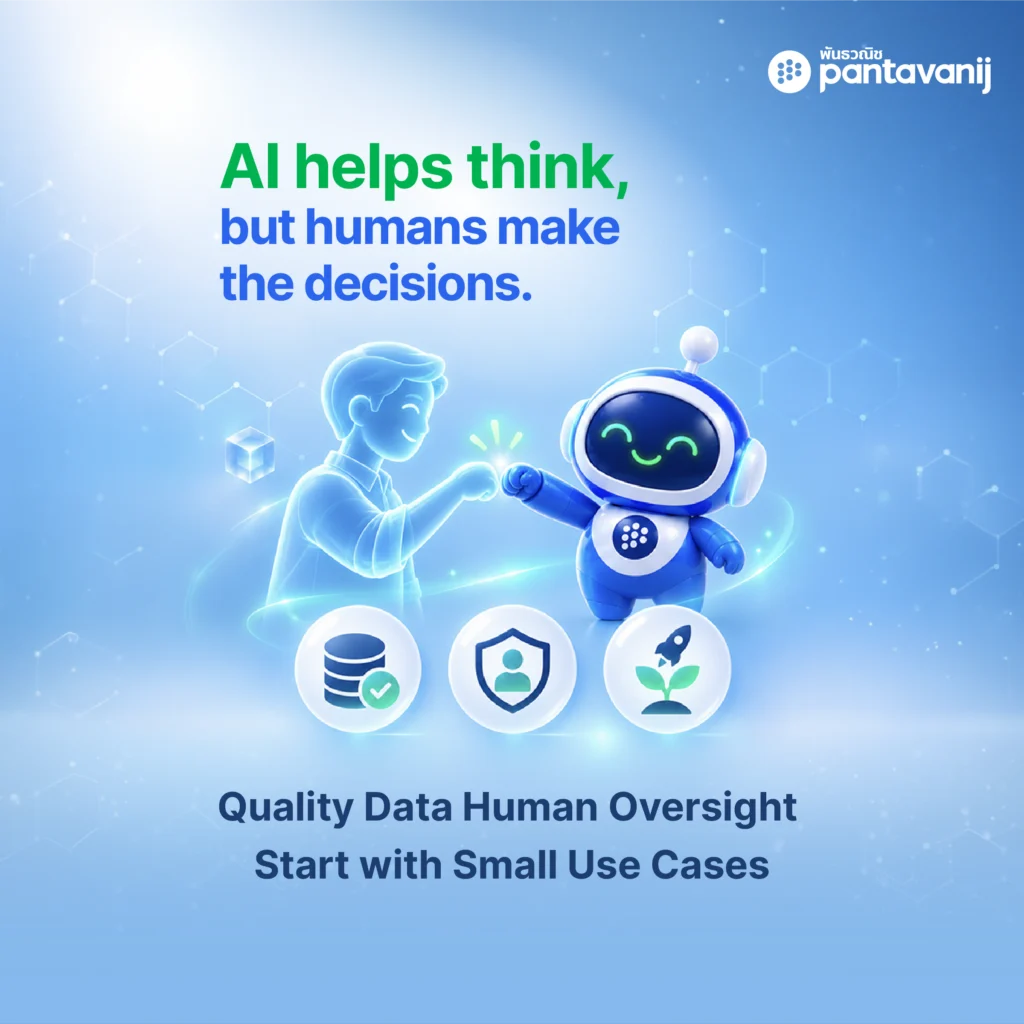
AI in eProcurement lets organizations get more from procurement data than recording and reporting. It can support planning, screening data, comparing options and monitoring risk across the process: pre-purchase, during purchase and post-purchase.
However, technology delivers its best results when data is of good quality, processes are clear and governance is appropriate. Important decisions still rely on business knowledge, contextual judgment and the accountability of experts.
Organizations considering developing their eProcurement system or building a roadmap for AI in procurement can consult Pantavanij’s team of experts to assess their processes, data readiness and a starting approach that fits their context.
- For organizations: Explore Solutions for Buyers
- For suppliers: See Solutions for Suppliers
Frequently Asked Questions about AI in eProcurement
Q1 : What is AI in eProcurement?
A : AI in eProcurement is the use of artificial intelligence together with electronic procurement systems to analyze data, reduce repetitive work, detect anomalies and support decision-making throughout the procurement process.
Q2 : How do AI in Procurement and Generative AI differ?
A : AI in Procurement is a broad term covering many technologies, such as Machine Learning, Predictive Analytics and Natural Language Processing. Generative AI is a type of AI focused on creating or summarizing content, such as drafting RFPs, summarizing proposals or explaining data from reports.
Q3 : At which procurement stages can AI be used?
A : AI can be used before purchase, for example in spend analysis and supplier search; during purchase, for example in reviewing and comparing proposals; and after purchase, for example in supplier follow-up, transaction analysis and risk management.
Q4 : Can AI choose suppliers in place of the procurement team?
A : AI can help screen, rank and summarize information against defined criteria, but supplier selection should remain under the review and approval of the responsible people, especially for high-value or high-risk purchases.
Q5 : What data does an organization need before starting with AI?
A : It depends on the use case. Generally it may include spend data, the Supplier Master, lists of goods and services, prices, purchase orders, contracts, deliveries, invoices and supplier evaluation results. Data should be accurate, current and have clearly defined usage rights.