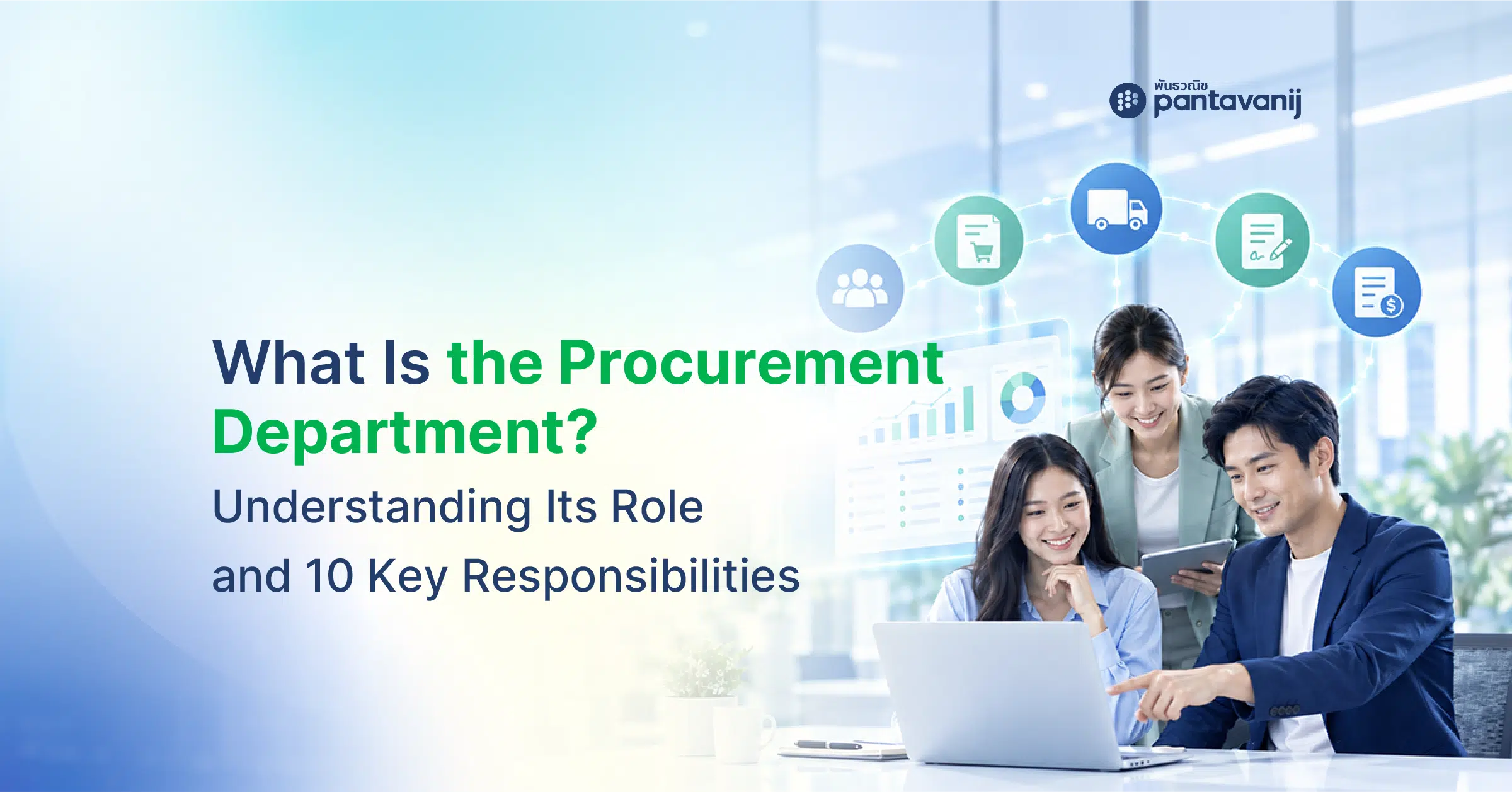
What Is the Procurement Department? Understanding Its Role and 10 Key Responsibilities
The Procurement Department is the unit responsible for sourcing the goods, raw materials, and services an organization needs. Its scope runs from gathering internal requirements and planning purchases, to selecting and comparing suppliers, negotiating terms, placing orders, tracking deliveries, and evaluating supplier performance — all so the organization receives the right goods and services at the right quality, cost, and time.
What Role Does Procurement Play in an Organization?
Procurement is one of the most important functions in both manufacturing and service businesses, because it links internal organizational needs with external goods, services, and suppliers — ensuring the organization has the resources it needs to operate, in sufficient and appropriate amounts.
Effective procurement management directly affects an organization’s competitiveness: cost control, quality maintenance, operational continuity, and the ability to respond to customer needs.
From a supply chain management perspective, procurement is also part of the “Source” process under the Supply Chain Operations Reference (SCOR) model, which reflects how procurement is a core part of overall supply chain management.
Why Is the Procurement Department Important to an Organization?
Procurement’s role goes beyond simply supplying enough goods or services to meet demand. Procurement decisions directly affect cost, business continuity, product and service quality, supplier relationships, and the organization’s overall competitiveness.
1. Cost Management
Procurement plays a key role in cost control — from demand planning, price comparison, and negotiation, to selecting the right suppliers. Rather than focusing on purchase price alone, procurement should consider the Total Cost of Ownership (TCO) to maximize long-term value for the organization.
2. Supply Continuity
If critical raw materials, goods, or services cannot be sourced on schedule, production and service delivery can be disrupted. Procurement is responsible for sourcing planning and supplier risk management so the organization has ongoing, reliable access to the resources it needs.
3. Quality Control
Procurement isn’t only about getting goods at a reasonable price — it must also uphold the organization’s quality and standards. Evaluating supplier quality, delivery capability, and reliability helps reduce the risk of substandard goods or late deliveries.
4. Supplier Relationship and Performance Management
Suppliers are part of the supply chain and directly affect business performance. A base of quality, reliable suppliers gives the organization access to better goods, services, and technology, and supports long-term partnership development.
5. Boosting Organizational Competitiveness
When an organization can control costs, maintain quality, ensure supply chain continuity, and manage suppliers effectively, procurement is no longer just a support function or cost center — it becomes a strategic partner that helps create value and competitive advantage.
10 Key Missions and Responsibilities of the Procurement Department
Procurement’s responsibilities span coordinating internal demand, managing costs, planning purchases, selecting and evaluating suppliers, analyzing markets, managing supplier relationships, adopting technology, tracking performance, and considering sustainability. These can be grouped into 10 key missions:
- Coordinate internally and externally
- Manage and reduce procurement costs
- Evaluate supplier performance
- Plan purchase orders effectively
- Select and manage suppliers
- Analyze the market and set procurement strategy
- Develop performance jointly with suppliers
- Adopt technology in procurement work
- Measure and improve procurement performance
- Prioritize sustainability and environmental responsibility
1. Coordinate Internally and Externally
Procurement acts as the bridge between internal departments and external suppliers — from gathering requirements for goods and services, to coordinating details and terms, to tracking purchasing and delivery — so every party can work together smoothly.
2. Manage and Reduce Procurement Costs
Cost management is one of procurement’s core missions. It requires weighing price, quality, and delivery performance together — not simply choosing the lowest-priced offer — to deliver value to the organization while maintaining fairness with suppliers.
3. Evaluate Supplier Performance
Procurement should evaluate suppliers across multiple dimensions: better quality, lower cost, faster sourcing and delivery, and greater reliability. This data supports decision-making and supplier management.
4. Plan Purchase Orders Effectively
Rush orders, a lack of long-term purchasing plans, or sudden changes to delivery schedules can create additional costs for the organization. Proper order planning and appropriate lead times reduce unnecessary costs and make procurement more efficient.
5. Select and Manage Suppliers
Supplier selection should follow criteria and strategies suited to each category of goods or services. The Supply Positioning Model can help define procurement strategy, while the Supplier Preferencing Model helps the organization understand how suppliers view it as a customer — supporting more appropriate buyer–supplier relationship management.
6. Analyze the Market and Set Procurement Strategy
Procurement should use market data to inform strategy — tools such as the Market Management Matrix can help determine which suppliers should be developed as partners, which should serve as backup options, and which need closer monitoring, allowing each supplier group to be managed appropriately.
7. Develop Performance Jointly with Suppliers
Procurement can work with suppliers to find ways to improve efficiency and reduce costs — for example, analyzing production processes, adopting new technology, or improving working methods — rather than relying solely on price negotiation to cut costs.
8. Adopt Technology in Procurement Work
Technology allows procurement data to be stored, connected, and used systematically — from MRP, MRP II, and ERP systems to e-Procurement platforms that support supplier management, sourcing and offer comparison, approval and ordering, and goods receipt and invoice management.
9. Measure and Improve Procurement Performance
Procurement should continuously track and measure its performance, since systems or working methods that once worked well may no longer fit a changing business environment. Analyzing performance results helps the organization spot problems and refine its procurement processes.
10. Prioritize Sustainability and Environmental Responsibility
Procurement should factor social and environmental considerations into supplier evaluation, prioritizing partners who act responsibly toward society and the environment across the supply chain — using relevant standards such as ISO as part of the evaluation criteria.
The Procurement Workflow: What Are the Steps?
Procurement doesn’t begin only when an organization needs to issue a purchase order — it covers everything from gathering requirements and planning, to finding and selecting suppliers, approving and issuing purchase orders, and receiving goods and verifying invoices. This can generally be broken into 5 main steps:
Step 1: Gather Requirements and Plan Procurement
The process starts by collecting requirements for goods, raw materials, or services from internal departments — identifying what’s needed, how much, when, and any relevant budget or conditions. This information allows procurement to plan sourcing appropriately, reduce rush purchases, and prepare for the supplier selection stage.
Step 2: Find, Select, and Negotiate with Suppliers
Once requirements are known, procurement searches for and vets suitable suppliers, considering business information, qualifications, operational capability, and related risks, before comparing offers and negotiating terms. Selection may involve a Request for Information (RFI), Request for Quotation (RFQ), Request for Proposal (RFP), or an online eAuction to help the organization compare suppliers and choose the right offer. On Pantavanij’s platform, Supplier 360 supports everything from registration and verification of business information and qualifications to supplier risk assessment.
Step 3: Approve and Process the Purchase Order
After selecting a supplier and agreeing on terms, the process moves to internal execution — creating a Purchase Requisition (PR), routing it for approval, and issuing a Purchase Order (PO) to the supplier. Using an e-Procurement system connects data and approval steps digitally, reducing paperwork and making it easier to track the status of the procurement process.
Step 4: Receive Goods and Verify Accuracy
When the supplier delivers the goods, the relevant department inspects and records the delivery as a Goods Receipt (GR), checking that items, quantities, and delivery details match the purchase order and agreed terms. Accurate goods-receipt data is essential for invoice verification and the subsequent financial process.
Step 5: Verify Invoices and Forward for Payment
The final step is matching the invoice against order and goods-receipt data to ensure billed amounts are accurate before passing the information to accounts payable and payment processing under the organization’s terms. An e-Procurement system can link PO, GR, and invoice data and feed it into ERP or accounting systems, reducing duplicate data entry and manual errors.
How Does Technology Improve Procurement Performance?
Since procurement must manage everything from planning and supplier sourcing/selection to approval, ordering, goods receipt, invoice verification, and risk management, adopting an e-Procurement system helps connect this data and these processes digitally — cutting paperwork and redundant steps while increasing transparency and auditability.
PTVN Procurement Suite is an end-to-end procurement platform built on four pillars:
- Strategic Planning & Analytics — gives organizations visibility into spend, supports budget planning, and enables deeper data analysis for decision-making
- Source to Contract — supports supplier sourcing and eAuctions through to contract management, keeping the process transparent and auditable
- Procure to Pay — connects PR, PO, GR, invoice matching, and data transfer into ERP or accounting systems for billing and payment, reducing duplicate work and errors
- Procurement Excellence — supports ESG management, supplier risk, and compliance, helping organizations manage procurement to defined standards
Every module is powered by an AI Intelligence Core, the platform’s central engine, along with the Taokae Chatbot to support day-to-day use.
Organizations looking to elevate their procurement processes can learn more about Pantavanij’s online procurement system for buyers.
Summary: The Role and Importance of Procurement
Procurement’s role spans planning requirements, controlling costs, selecting and managing suppliers, executing purchase orders, and tracking and improving process performance — all of which affect cost, quality, supply chain continuity, and organizational competitiveness.
As procurement processes grow more complex, adopting e-Procurement systems helps connect data and workflows, reduce duplication, increase transparency, and empower procurement teams to make more effective, data-driven decisions.
Frequently Asked Questions (FAQ)
What does the procurement department do?
Procurement plans and executes the sourcing of goods, raw materials, and services an organization needs — from gathering requirements, selecting and evaluating suppliers, comparing offers, and negotiating, to issuing orders, tracking deliveries, and evaluating procurement outcomes — in order to control cost, quality, and business continuity.
Is “ฝ่ายจัดซื้อ” (purchasing department) different from “Procurement”?
In Thai, “ฝ่ายจัดซื้อ” is commonly used for the department handling either Purchasing or Procurement. In process terms, however, Purchasing tends to focus on buying activities — issuing purchase orders and tracking delivery — while Procurement has a broader scope, covering strategy setting, sourcing and supplier management, negotiation and contract management, and procurement performance improvement.
Which departments does procurement need to coordinate with?
Procurement works with many functions — the departments requesting goods and services, finance and accounting, warehousing, legal, approval authorities, and external suppliers — to ensure the process from purchase request to goods receipt and payment runs correctly.
How does an e-Procurement system help the procurement department?
An e-Procurement system connects the procurement process digitally — from supplier management, sourcing and offer comparison, approval and order issuance, to goods receipt and invoice verification — reducing paperwork and duplicate steps, increasing transparency, and making data easier to audit.
How should procurement choose a supplier?
Supplier selection should look beyond price alone — evaluating product and service quality, delivery capability, reliability, operational capacity, and fit with the organization’s needs — to find a supplier that’s the right match on cost, quality, and business continuity.