
What Is Supplier Risk Management? How to Assess Suppliers with Greater Confidence
Supplier Risk Management is the process of identifying, assessing, prioritizing, mitigating, and monitoring risks associated with suppliers to prevent negative impacts on business operations, finances, compliance, reputation, and supply chain continuity. It is an ongoing process that begins before supplier selection, continues throughout the business relationship, and extends to periodic reviews and contract renewals.
What Is Supplier Risk Management, and Why Is It Important for Procurement?
The goal of Supplier Risk Management is not to eliminate all risks, but to help organizations identify risks early, assess their potential impact, and prepare appropriate mitigation measures before problems occur. Depending on the context, related terms such as Vendor Risk Management and Third-Party Risk Management may also be used, with the latter generally covering a broader range of risks associated with external parties.
For Procurement and Sourcing teams, Supplier Risk Management helps organizations:
- Select suppliers based on price, quality, capabilities, and risk exposure rather than price alone.
- Reduce the likelihood of supply chain disruptions caused by delivery delays, insufficient production capacity, or overreliance on a single supplier.
- Verify compliance, business standards, and relevant requirements before establishing a business relationship.
- Prepare alternative suppliers or contingency plans for critical goods and services.
- Support collaborative decision-making among Procurement, Finance, Legal, Compliance, and other relevant departments.
- Maintain business continuity while minimizing cost-related and reputational impacts.
What Is Supplier Risk Assessment? How Does It Differ from Supplier Risk Management?
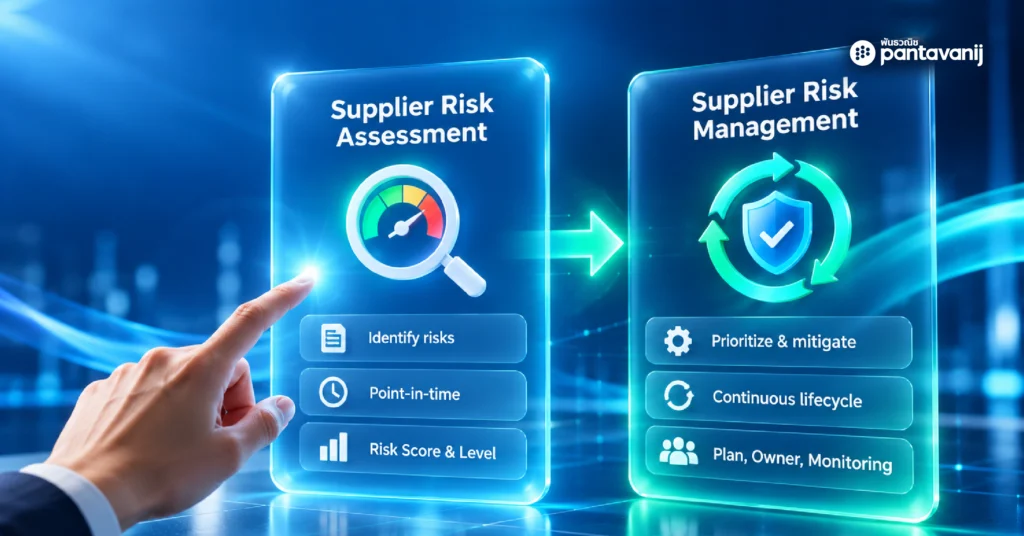
Supplier Risk Assessment is the process of identifying the types of risks associated with a supplier, evaluating their likelihood of occurrence, and determining the potential impact on the organization. The results may be presented as a Risk Score, Risk Level, or Risk Profile to support supplier comparison and prioritization.
Supplier Risk Assessment is one component of Supplier Risk Management, but it does not cover the entire process.
|
Category |
Supplier Risk Assessment |
Supplier Risk Management |
| Primary function | Identify and assess risks | Manage risks from assessment through ongoing monitoring |
| Key question | What risks does a supplier pose, and how severe are they? | Which risks should be addressed first, how should they be managed, and who is responsible? |
| Process | An assessment conducted at a specific point in time | An ongoing process throughout the supplier lifecycle |
| Outcomes | Risk Score, Risk Level, and Risk Profile | Mitigation Plan, assigned owner, timeline, monitoring, and reassessment |
| Objective | Identify and compare supplier risks | Reduce the likelihood of problems and limit their impact on the business |
In simple terms: Assessment identifies the risks associated with a supplier, while Management uses those findings to prioritize, mitigate, and monitor risks before they develop into business problems.
What Types of Supplier Risks Should Procurement Teams Assess?
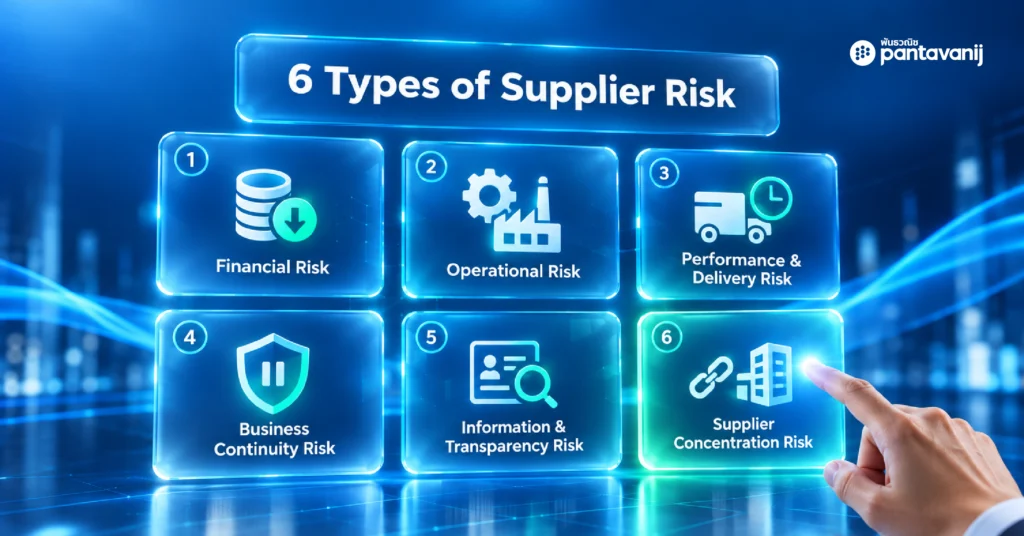
Supplier risk is not limited to the possibility of late deliveries. It also includes financial stability, operational capabilities, delivery performance, and business continuity. Categorizing risks helps Procurement teams identify the information they need to verify and evaluate suppliers more comprehensively before making sourcing decisions.
1. Financial Risk
Financial difficulties can affect a supplier’s ability to manufacture products, fulfill deliveries, or provide services consistently. Procurement teams should review financial information over several years to identify trends rather than relying solely on the most recent year’s results.
What to check: Financial statements, revenue, liabilities, financial performance, and historical financial trends.
2. Operational Risk
Even financially stable suppliers may face limitations in production capacity, staffing, or internal processes. Procurement teams should assess whether a supplier’s operational capabilities are sufficient for the scale and criticality of the goods or services required.
What to check: Production capacity, resources, staffing, operational processes, operating standards, and the ability to fulfill purchase orders.
3. Performance and Delivery Risk
Supplier performance can change throughout the business relationship. Issues may include late deliveries, products that fail to meet quality standards, or recurring operational problems. Continuous monitoring helps organizations identify warning signs before they affect business operations.
What to check: On-time delivery performance, product and service quality, compliance with Service Level Agreements (SLAs), complaints, and historical incidents.
4. Business Continuity Risk
Events such as the loss of required licenses, labor disputes, changes in corporate structure, or external disruptions may force a supplier to suspend operations. This risk is particularly important when dealing with suppliers that provide critical goods or services.
What to check: Company status, significant organizational changes, licenses and permits, emergency response plans, and the ability to maintain business operations during disruptions.
5. Information and Transparency Risk
Organizations should not rely exclusively on information provided by suppliers. They should verify information that establishes a supplier’s identity, status, and credibility. Any unclear or inconsistent information should be investigated further before entering into a business relationship.
What to check: Legal entity information, directors, shareholders, corporate structure, and changes to key company information.
6. Supplier Concentration Risk
Relying on a single supplier for critical goods or services can expose a business to immediate disruption if that supplier encounters problems. Procurement teams should assess the level of dependency and the availability of alternative sources of supply.
What to check: Procurement spend by supplier, the criticality of goods and services, the number of alternative suppliers, and the readiness of contingency plans.
How to Assess Supplier Risk in 6 Steps
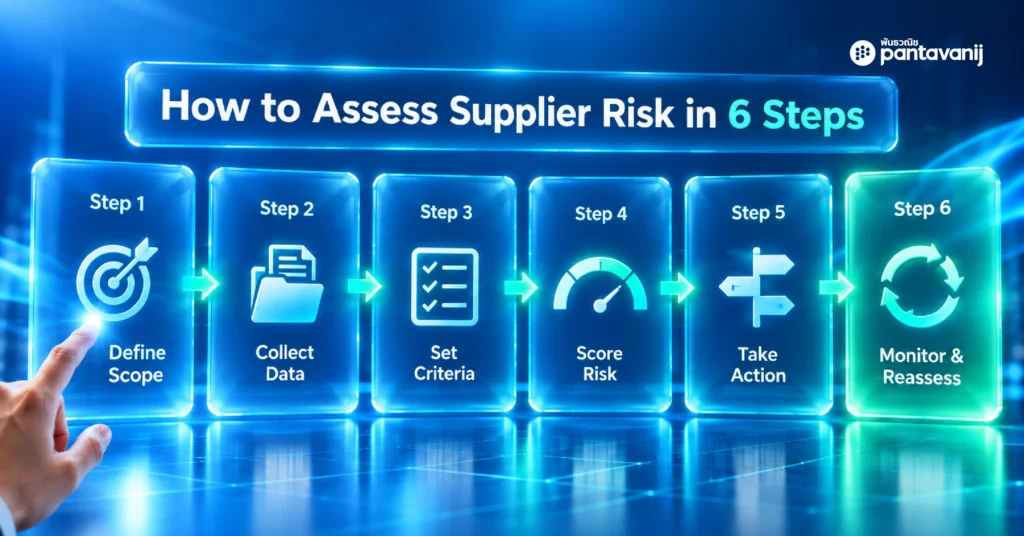
Supplier risk assessment should begin with a clearly defined scope, followed by the collection of relevant information and the application of consistent evaluation criteria. This approach helps ensure that assessment results can support approval decisions, risk mitigation planning, and ongoing monitoring.
Step 1: Define the Assessment Scope
Start by identifying which supplier needs to be assessed and why. Different suppliers have different levels of importance to the business.
Consider the following questions:
- How critical are the goods or services to business operations?
- Which parts of the organization would be affected if the supplier failed to deliver?
- How easily could the supplier be replaced?
- Does the supplier have access to the organization’s critical data or systems?
Suppliers that provide critical goods or services, are difficult to replace, or may create compliance risks should undergo more detailed assessments than standard suppliers.
Not every supplier requires the same level of assessment. Basic suppliers may only need standard due diligence, while critical suppliers that are difficult to replace or could significantly affect business operations require more comprehensive assessments and more frequent monitoring.
Step 2: Collect Supplier Information
Gather information from suppliers, internal company records, and verifiable external sources, such as:
- Company registration details and legal entity status
- Financial information
- Licenses, certifications, and compliance documentation
- Delivery and quality performance history
- Shareholder information and details of related parties
- Policies covering business ethics, labor, human rights, and environmental responsibility
- Sanctions and watchlist screening results
Collecting information from multiple sources reduces reliance on supplier self-assessments and helps provide a more objective view of supplier risk.
Step 3: Establish Assessment Criteria
Define assessment criteria based on the category of goods or services and the supplier’s importance to the organization. Examples include:
- Financial stability
- Delivery capabilities
- Product and service quality
- Completeness of documentation
- Compliance with laws and company policies
- Ethics and social responsibility
- Emergency response and recovery capabilities
Each criterion should have a clear definition so that evaluators can apply consistent standards and compare suppliers fairly.
Step 4: Score and Categorize Supplier Risks
Evaluate suppliers using a consistent methodology. Organizations may use a numerical scale, such as 1–5, or categorize risks as Low, Medium, or High.
For example:
- Low Risk: Information is complete, requirements are met, and no significant issues have been identified.
- Medium Risk: Potential concerns have been identified, or additional information is required.
- High Risk: Significant issues have been identified that could affect delivery, compliance, or business continuity.
For critical suppliers, organizations may assign greater weight to key criteria such as delivery performance, financial stability, or compliance.
Step 5: Define Actions Based on Risk Levels
Assessment results are valuable only when they lead to clear decisions and actions.
|
Risk Level |
Recommended Actions |
| Low | Approve the supplier through the standard approval process. |
| Medium | Request additional documentation, grant conditional approval, or establish a corrective action plan. |
| High | Conduct further due diligence, develop a risk mitigation plan, consider alternative suppliers, or withhold approval. |
If an unacceptable risk is identified, such as failure to meet legal requirements or a match against a sanctions list, the organization may establish it as a mandatory rejection criterion, even if the supplier meets other assessment requirements.
Example: If a supplier is the sole source of a critical component and begins experiencing delivery delays, the organization should closely monitor the situation while preparing alternative suppliers and contingency plans to minimize potential disruptions.
Step 6: Monitor and Reassess Supplier Risks
Establish reassessment schedules based on risk levels and reassess suppliers when significant warning signs emerge, such as:
- Declining delivery performance or product quality
- Expiring documentation or certifications
- Changes in financial status or shareholding structure
- Negative news or compliance concerns
- Changes to the scope of work or contractual terms
- Events that could affect production facilities or the supply chain
Continuous monitoring helps Procurement teams identify changes and take action before they negatively affect the business.
Process Summary: Define the scope → Collect information → Establish criteria → Score risks → Determine actions → Monitor and reassess.
From Supplier Risk Assessment to Continuous Risk Monitoring
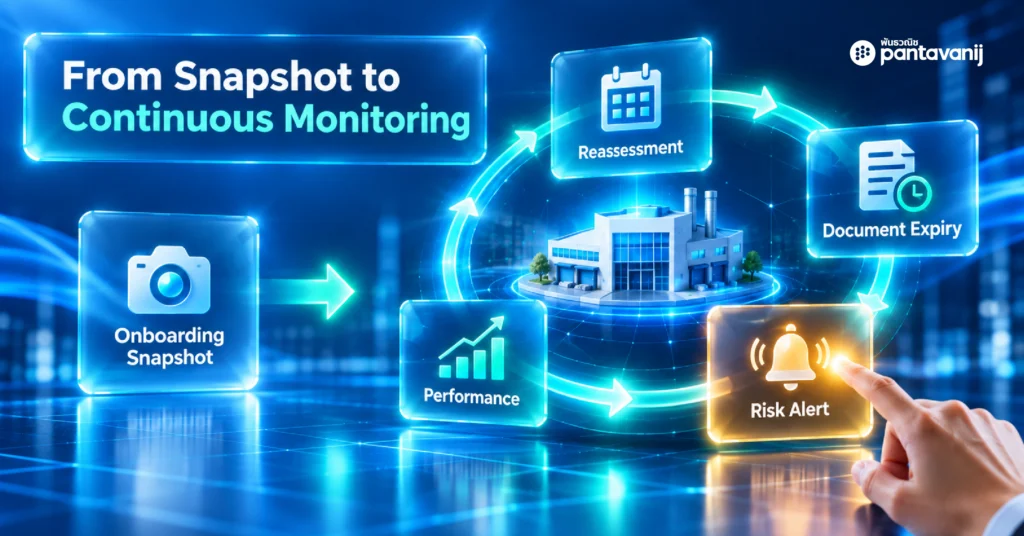
An assessment conducted during supplier onboarding provides only a snapshot of the supplier’s risk profile. Financial health, performance, compliance, and external factors can change over time. Therefore, Supplier Risk Assessment should be integrated with continuous monitoring of risk indicators and supplier performance.
By analyzing these data together, Procurement teams can identify emerging risks earlier and determine when to take corrective action, diversify procurement sources, or activate alternative suppliers.
Learn more about connecting supplier information and improving supplier management in our article: Supplier 360: Transforming Supplier Management into a Sustainable Business Advantage.
When Should Organizations Use a Supplier Risk Management System?
Organizations can start assessing suppliers using checklists or spreadsheets when their processes are relatively simple. However, they should consider implementing a dedicated system when:
- Supplier information and documents are scattered across multiple sources.
- Different departments use inconsistent assessment criteria.
- Document verification and status tracking take too much time.
- Supplier information, documentation, and assessment results require continuous monitoring.
- Comparing supplier assessment results is difficult.
- A centralized source of information is needed to support decision-making.
How Does Supplier 360 Help Organizations Select and Assess Suppliers with Greater Confidence?
Supplier360 (S360) by Pantavanij is a supplier qualification and business assessment service that provides Procurement teams with information to support supplier selection. It helps reduce the time and costs associated with manual verification while providing a centralized repository for assessment results to support decision-making.
The screening process draws on multiple data sources, including information from the Department of Business Development, the Legal Execution Department, the Department of Local Administration, and relevant Dow Jones databases covering sanctions, control and ownership, high-profile criminals, and PEP/RCA (Politically Exposed Persons and Related or Close Associates).
The service also covers key areas of supplier business assessment, including:
- Business ethics
- Product and service quality and standards
- Respect for human rights
- Fair labor practices
- Occupational health, safety, and working conditions
- Community and social responsibility
- Environmental responsibility
For Procurement and Sourcing buyers, these insights support supplier discovery, screening, comparison, and selection. Organizations can benefit from:
- Reduced time and costs for supplier verification through structured screening processes and consolidated information.
- Greater confidence in supplier selection by using verification and assessment results to support decisions.
- Reduced supply chain risk by identifying suppliers that fail to meet screening requirements or applicable standards.
- Centralized assessment results for easier monitoring, audit trails, and information sharing across relevant teams.
- A broader pool of qualified suppliers to expand sourcing options.
- More consistent supplier selection standards supported by verifiable information and assessment results.
Organizations should also establish clear risk appetite thresholds, approval criteria, and ownership responsibilities. Assessment results should be considered alongside category knowledge and supplier performance.
Conclusion: Assess Supplier Risks to Make More Confident Sourcing Decisions
Supplier Risk Management is not about selecting suppliers with zero risk. It is about understanding which suppliers pose risks, how significant those risks are, and what actions should be taken to manage them. Procurement and Sourcing teams should apply clear assessment criteria, conduct regular evaluations, and monitor changes throughout the business relationship.
If your organization wants to improve supplier qualification and business assessment, explore Supplier360 by Pantavanij to support supplier selection with verifiable information.