
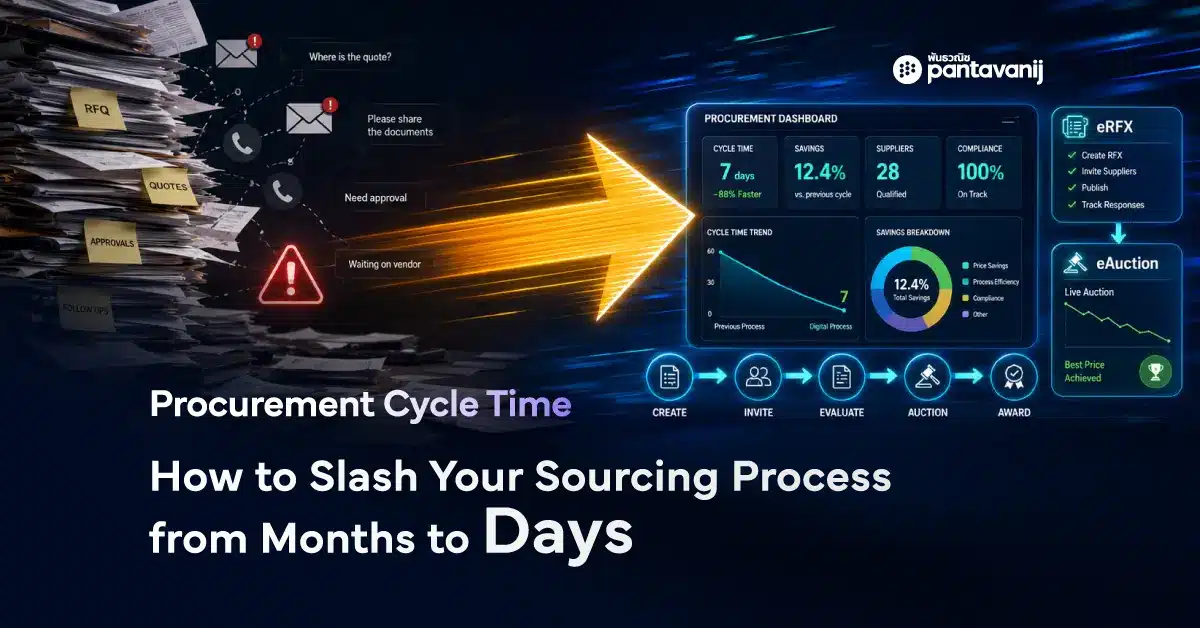
Procurement Cycle Time: How to Slash Your Sourcing Process from Months to Days
In today’s hyper-competitive business landscape, time is your most valuable — and most finite — resource. Yet traditional procurement processes remain one of the biggest time drains in any organization.
From identifying vendors and distributing RFQs, to enduring multiple rounds of back-and-forth negotiation, a single purchase cycle can consume weeks or even months before a purchase order is finally issued.
This prolonged Procurement Cycle Time doesn’t just create missed business opportunities — it exhausts procurement teams and prevents them from doing the strategic work that actually moves the needle.
The good news? Modern procurement technology can compress what once took a month into a matter of days. This guide breaks down the root causes of procurement delays and the three proven steps to solve them.
What Is Procurement Cycle Time — And How Is It Measured?
Procurement Cycle Time is the total elapsed time from the initiation of a procurement request (identifying a need) through to the delivery of goods or services and final payment.
The Core Stages of a Procurement Cycle
|
Stage |
Description |
Traditional Timeline |
| 1. Needs Identification | Identify need and approve PR |
3–7 days |
| 2. Supplier Sourcing | Find and contact suppliers |
5–14 days |
| 3. RFQ / RFP | Issue request and collect quotes |
7–21 days |
| 4. Price Comparison | Compare bids and negotiate |
5–14 days |
| 5. Approval & Award | Get sign-off and notify supplier |
3–10 days |
| 6. PO Issuance | Issue PO and manage delivery |
2–7 days |
| Total (Avg.) |
25–73 days (1–2.5 months) |
Stages 2–4 are the biggest bottlenecks — and precisely where smart technology delivers the greatest impact.
Why Procurement Delays Are a Dangerous Hidden Cost
Many organizations treat procurement speed as a convenience issue. In reality, a long Procurement Cycle Time creates a chain reaction of costs across the entire business.
3 Hidden Costs Most Organizations Overlook
💸 1. Loss of Negotiating Power
When urgency replaces planning, procurement teams lose the time needed to benchmark markets or negotiate terms. The result: paying a premium above market price unnecessarily.
🏭 2. Project Bottlenecks and Revenue Delays
Delayed materials or services ripple outward — disrupting production schedules, delaying product launches, and ultimately slowing the organization’s Time-to-Market in a window where competitors are moving forward.
🧠 3. Wasted Strategic Talent
Procurement professionals capable of driving cost strategy spend 60–70% of their time on manual follow-up tasks — resending emails, chasing supplier confirmations, building comparison spreadsheets — instead of creating value.
💡 Expert Insight: “Every extra day in your Procurement Cycle Time is a day your competitor has an edge. Speed in procurement doesn’t mean cutting corners — it means your organization is more agile.”
3 Steps to Unlock Sourcing Speed with Pantavanij
Pantavanij’s solutions are engineered to eliminate time constraints at every stage of the procurement workflow — without sacrificing quality, compliance, or control.
Step 1 — Bypass Tedious Sourcing with eRFX
Gone are the days of calling suppliers one by one or waiting days for email replies that may never arrive.
Pantavanij’s eRFX platform gives you instant access to a verified Supplier Directory of over 30,000 vendors. You can:
- Build RFQ/RFP/RFI forms in minutes, not hours
- Send requests to multiple suppliers simultaneously in a single action
- Receive responses and let the system generate automated Price Comparisons with visual summaries
- Eliminate manual Excel work entirely
Result: A process that typically takes 7–21 days is compressed to 2–3 days.
👉 Explore all Pantavanij eRFX Features
Step 2 — Close Negotiations in 30 Minutes with eAuction
Weeks of back-and-forth email negotiations are replaced by a structured, transparent online bidding event.
Here’s how Pantavanij’s eAuction works:
- Set the auction date and time in advance
- Pre-qualified suppliers log in and submit bids in real time
- Each supplier sees their competitive position (without revealing others’ exact prices)
- Market competition drives prices to their natural floor — transparently
- In 30 minutes, you have a final result and the best available market price
Result: A negotiation process that typically takes 5–14 days concludes in half an hour.
👉 Learn more about Pantavanij’s eAuction Platform
Step 3 — Centralize Data for Instant Executive Decisions
After sourcing and negotiation, the traditional bottleneck shifts to approvals — gathering data, preparing reports, and routing physical documents for sign-off.
Pantavanij eliminates this delay by:
- Automatically recording and visualizing all data from eRFX to eAuction results
- Generating Price Summary dashboards ready for executive review
- Enabling one-click Supplier Award approvals from anywhere — no paper routing required
- Maintaining a full Audit Trail for compliance and transparency
Result: An approval process that typically takes 3–10 days reduces to same-day or next-day.
👉 See Pantavanij’s Approval Workflow Features
Before vs. After — The Numbers That Tell the Story
Procurement Cycle Time Comparison
|
Stage |
Traditional | With Pantavanij |
Time Saved |
|
Supplier Sourcing |
5–14 days | 1–2 days | ~85% |
|
RFQ & Price Collection |
7–21 days | 2–3 days | ~80% |
|
Negotiation |
5–14 days | 0.5 days (30 min) | ~95% |
|
Approval & Award |
3–10 days | 1 day | ~80% |
| Total (Avg.) | 25–60 days | 5–10 days |
~70% |
These aren’t gains made by cutting corners. They’re the result of replacing manual, sequential steps with intelligent, parallel digital workflows.
Which Organizations Benefit Most from Reducing Procurement Cycle Time?
While every organization benefits from faster procurement, these industries typically see the most immediate impact:
- High-Volume Procurement Organizations: Manufacturers, hospitals, retailers managing thousands of SKUs
- Project-Based Businesses: Construction, IT services, event management where deadlines are fixed
- Margin-Sensitive Industries: Food & beverage, packaging, automotive components where input cost directly impacts profitability
- Government & State Enterprises: Where procurement transparency and auditability are non-negotiable requirements
👉 View Industry-Specific Case Studies for Procurement Cycle Time Reduction
Speed, Efficiency, and Cost Savings — All at Once
Reducing Procurement Cycle Time is not about rushing decisions or skipping due diligence. It’s about deploying the right technology to eliminate redundancies, increase transparency, and give your procurement team their time back.
The Pantavanij platform has demonstrated the ability to reduce procurement process complexity by 50–70% — while simultaneously driving measurable cost reductions through more competitive supplier engagement.
In 2026, the question isn’t whether your organization can afford to modernize procurement. It’s whether you can afford not to.
👉Contact Pantavanij for a free eRFX and eAuction demo
Frequently Asked Questions (FAQ) — Procurement Cycle Time
Q1: What is Procurement Cycle Time and why does it matter?
A: Procurement Cycle Time is the total time from initiating a procurement request to receiving goods or services and closing the transaction. It matters because it directly affects organizational agility, cost efficiency, and competitive performance. A long cycle time means missed opportunities, inflated costs, and wasted human capital.
Q2: What is a good benchmark for Procurement Cycle Time?
A: This varies by procurement type and complexity. Organizations using manual processes typically average 25–60 days per cycle. Organizations using integrated digital platforms like Pantavanij can reduce this to 5–10 days for most standard procurement activities.
Q3: What is the difference between eRFX and a traditional RFQ?
A: An RFQ (Request for Quotation) is a document requesting price submissions. eRFX is a digital platform that handles RFQs, RFPs, and RFIs in a single system, with added capabilities including simultaneous multi-supplier outreach, automated price comparison, digital document management, and full audit trails.
Q4: What types of procurement are best suited for eAuction?
A: eAuctions work best when (1) multiple qualified suppliers exist in the market, (2) product or service specifications can be clearly defined, and (3) price is a primary selection criterion. Ideal categories include raw materials, packaging, IT hardware, logistics services, and general commodity goods.
Q5: Will eAuction lead to lower quality suppliers winning bids?
A: Not with Pantavanij’s approach. All suppliers participating in an eAuction have completed pre-qualification to meet defined quality and compliance standards. Competition occurs between suppliers of equivalent capability — driving price down to market rate, not quality.
Q6: How long does it take to implement eRFX or eAuction?
A: Pantavanij’s platform is designed for fast adoption. Procurement teams can run their first eRFX within the first day of onboarding. eAuctions require brief setup and supplier invitation in advance, but no advanced technical knowledge is required. Pantavanij’s team provides full onboarding support and ongoing assistance throughout the process.
References
-
- Adapted and inspired by e-procurement.com: Procurement Trends 2026
- And penny.co: Procurement in 2026 — 5 Trends Every Company Should Prepare For