

Supplier Onboarding Best Practices: Build a Trusted Supplier Network Faster, With KPIs & Benchmarks
Let’s talk about supplier onboarding — a step many organizations underestimate, even though it’s where every supplier relationship begins.
Adding a new supplier to an organization’s system often takes weeks — gathering multiple documents, verifying accuracy, and coordinating across departments. A slow supplier onboarding process doesn’t just cost business opportunities; it also increases compliance risk when supplier data is incomplete or improperly vetted.
Many organizations treat onboarding as purely administrative, when in fact this step determines how smoothly the relationship with that supplier will run long-term. The more standardized and efficient onboarding is, the lower the risk — and the stronger the first impression a supplier gets of your organization.
This article outlines best practices for fast, secure supplier onboarding, along with the KPIs to track, the formulas behind them, rough benchmarks, and common mistakes to avoid — helping you build a trustworthy supplier network.
Why Supplier Onboarding Matters
Lost Business Opportunities
Slow onboarding means missing out on high-quality suppliers with limited availability — especially in-demand suppliers who may simply choose a competitor with a faster process.
Compliance Risk
Improperly vetted suppliers can introduce legal or ethical issues, such as labor standard violations or missing licenses — problems that can damage an organization’s reputation long-term.
Poor Supplier Experience
Complex processes push quality suppliers toward competitors instead, particularly when they’re asked to resubmit documents multiple times or have no visibility into their approval status.
Incomplete Data Hampers Decisions
Procurement teams can’t fully evaluate suppliers without complete information — such as financial standing or quality certifications — captured from the start.
Key Concepts You Should Know Before Designing Your Onboarding Process
What Is Supplier Onboarding?
The process of collecting, verifying, and approving new suppliers into an organization’s database — covering legal documents, licenses, and initial risk assessment — before that supplier can receive a PO or begin transacting with the organization.
Supplier Master Data
Centralized supplier information shared across the organization — company details, certifications, transaction history — which must remain accurate and up to date, since other departments, such as accounting and finance, rely on the same data.
Vendor Risk Screening
Initial due diligence to assess supplier risk before engagement, including financial standing, regulatory compliance history, or any record of being blacklisted by regulatory bodies.
What Is Supplier Risk Tiering?
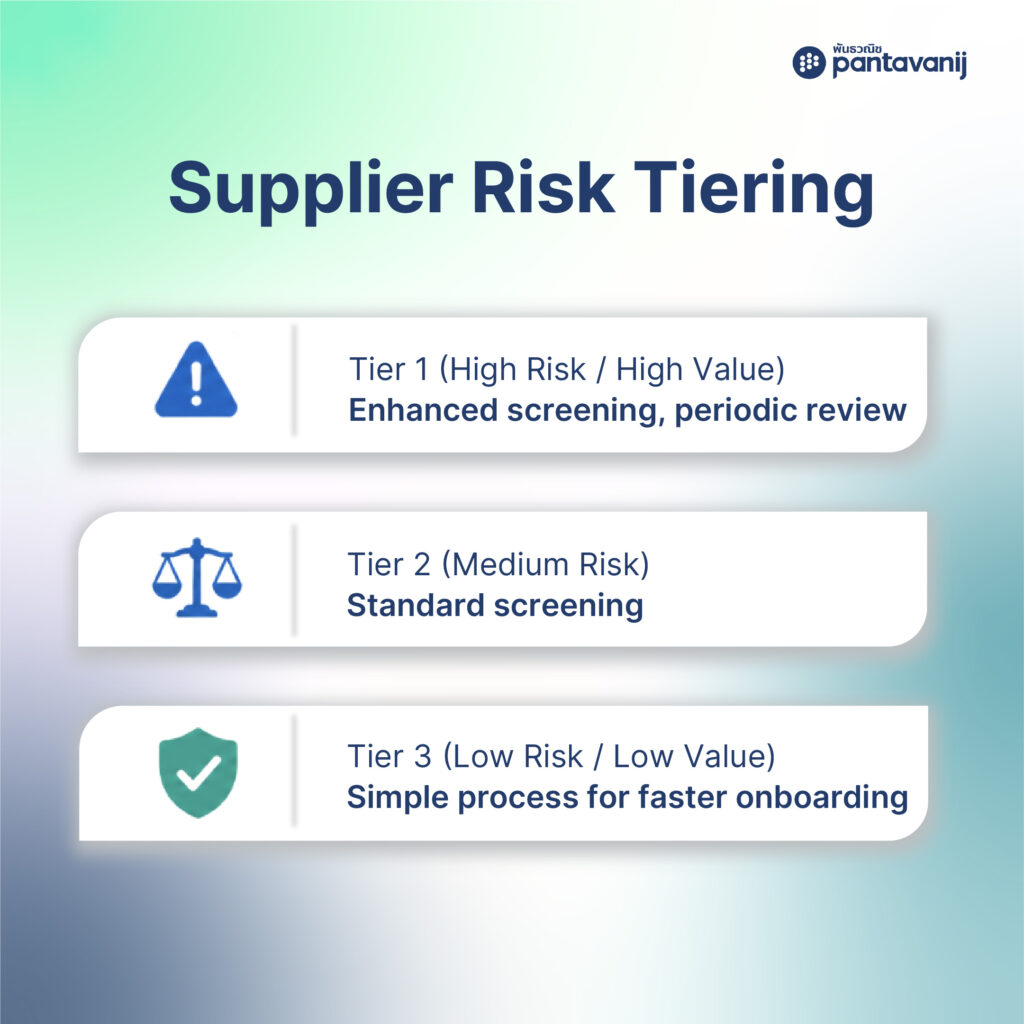
Supplier risk tiering is the practice of classifying suppliers into risk levels based on factors like transaction value, strategic importance, or the category of goods/services supplied — so the depth of screening matches the actual risk.
A typical tiering structure:
- Tier 1 (High Risk / High Value) — Suppliers with high transaction value or in high-risk categories, such as critical raw materials. These require intensive screening and periodic re-verification.
- Tier 2 (Medium Risk) — Mid-value suppliers, screened under standard procedures.
- Tier 3 (Low Risk / Low Value) — Small suppliers with low transaction value, onboarded through a lighter, faster process.
Why supplier risk tiering matters: Applying the same screening depth to every supplier, regardless of risk, slows down onboarding unnecessarily for low-risk suppliers while potentially under-screening high-risk ones. Risk tiering lets procurement teams allocate time and resources where they matter most.
Learn more about Supplier Risk Intelligence 2026
The Supplier Onboarding Process You Should Standardize
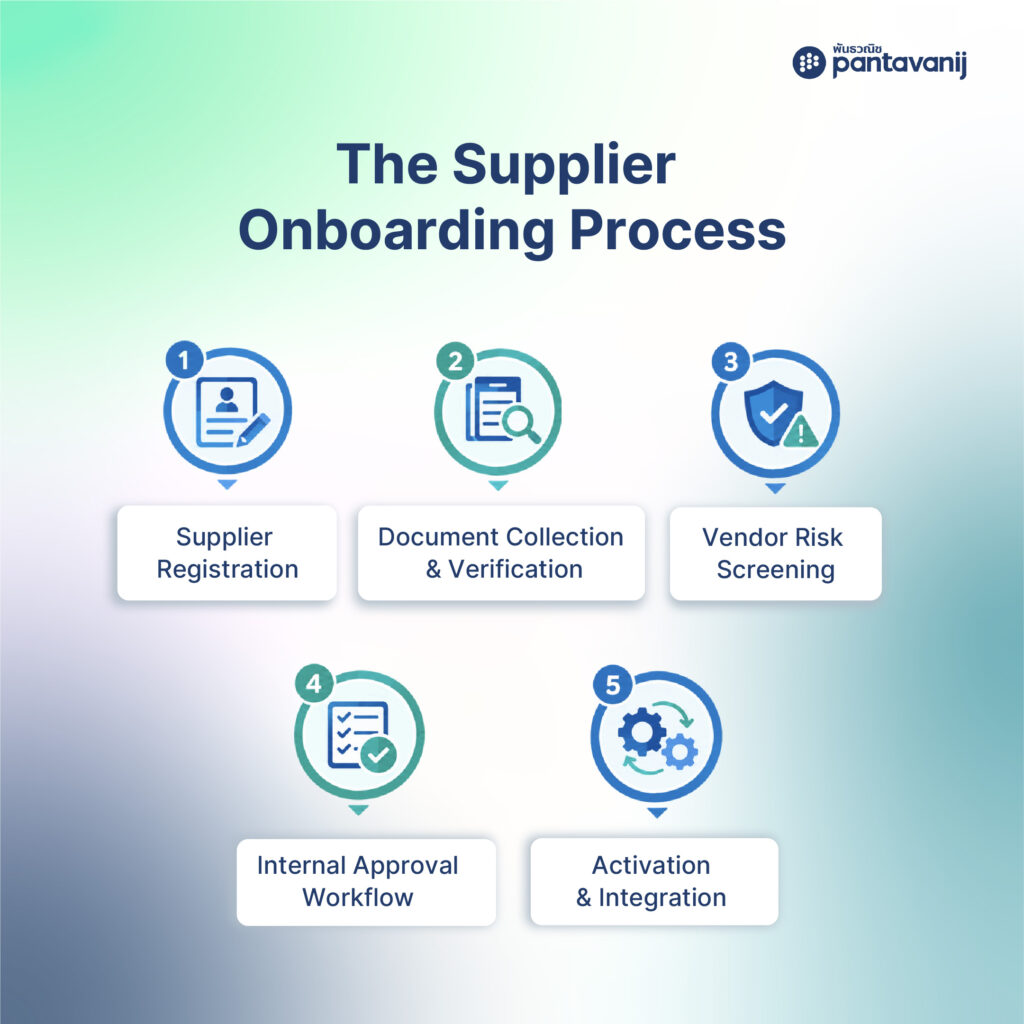
1. Supplier Registration
Suppliers submit initial information through a single standardized digital form instead of sending documents in various formats via email.
2. Document Collection & Verification
Documents are collected against a predefined checklist — such as company registration certificates and tax registration — and completeness is verified automatically.
3. Vendor Risk Screening
Risk is assessed according to the assigned risk tier before the supplier is approved into the master database.
4. Internal Approval Workflow
The request routes to relevant stakeholders — procurement, legal, finance — for approval in the defined sequence.
5. Activation & Integration
Once approved, supplier data automatically connects to other procurement systems, and the supplier can begin receiving POs immediately.
Learn more about Supplier Connect Solution
KPI Table & Formulas to Track After Digital Onboarding
| KPI | Formula | Why It Matters |
| Onboarding Cycle Time | Average (date supplier is approved − date registration started) | Measures overall onboarding process speed |
| Document Completion Rate | (Suppliers who submitted complete documents on the first attempt ÷ Total suppliers registered) × 100 | Reflects the quality of the checklist and form clarity |
| Supplier Activation Rate | (Suppliers successfully onboarded and transacting ÷ Total suppliers who started registration) × 100 | Measures how many onboarded suppliers actually become active |
| Risk Screening Turnaround Time | Average time from document submission to risk screening result | Highlights bottlenecks in the screening step |
| Time to First Transaction | Average (date of first transaction − date supplier was approved) | Measures how quickly a supplier becomes operationally ready |
| Onboarding Cost per Supplier | Total onboarding operating cost ÷ Number of suppliers successfully onboarded | Compares cost efficiency before vs. after digital onboarding |
| Supplier Compliance Rate | (Suppliers with complete, non-expired documents ÷ Total suppliers in database) × 100 | Reflects the long-term health of the supplier database |
Tip: Start by tracking onboarding cycle time and document completion rate first — they reflect the most common bottlenecks most clearly.
Rough Indicative Benchmarks
The figures below are rough, indicative industry benchmarks for comparison. Actual numbers vary by company size, industry, and the complexity of the product/service category — use them as directional targets, not fixed standards.
| KPI | Mostly-Manual Process | Digital Onboarding (Leading Practice) |
| Onboarding Cycle Time | 2-4 weeks | 3-5 business days or faster |
| Document Completion Rate (first attempt) | Below 50% | 80%+ |
| Risk Screening Turnaround Time | Several days to a week | Within 1-2 days |
| Supplier Activation Rate | Varies widely based on document complexity | Notably higher when suppliers use a self-service portal |
Common Mistakes When Designing an Onboarding Process
1. No Clear Document Checklist Upfront
Leads to multiple rounds of follow-up document requests, wasting time on both sides and creating an unprofessional impression for the supplier.
2. Applying the Same Screening Depth to Every Supplier
Without risk tiering, low-risk small suppliers get burdened with unnecessarily heavy processes, while high-risk suppliers may not be screened thoroughly enough.
3. Conducting Risk Screening Too Late
Screening risk after transactions have already begun, instead of at the very first step, makes it far harder to address issues once discovered.
4. No Real-Time Status Tracking
Neither the supplier nor the procurement team knows where onboarding is stuck, resulting in unnecessary back-and-forth email follow-ups.
5. Supplier Master Data Not Connected to Other Systems
Once onboarding is complete, data that isn’t automatically pushed to procurement or accounting systems requires re-entry — increasing the risk of mismatched records.
6. No Alerts for Expiring Documents
Certifications like ISO or business licenses can lapse without anyone noticing, leaving a supplier non-compliant without the organization realizing it.
Best Practices
- Create a single standardized digital onboarding form to reduce confusion from varied document formats.
- Define a clear document checklist upfront to avoid repeated requests.
- Conduct risk screening from day one, with tiers matched to each supplier’s risk level.
- Provide a self-service supplier portal to reduce procurement team workload.
- Track onboarding status in real time to eliminate approval bottlenecks.
- Measure KPIs consistently to drive continuous process improvement.
How Technology Helps
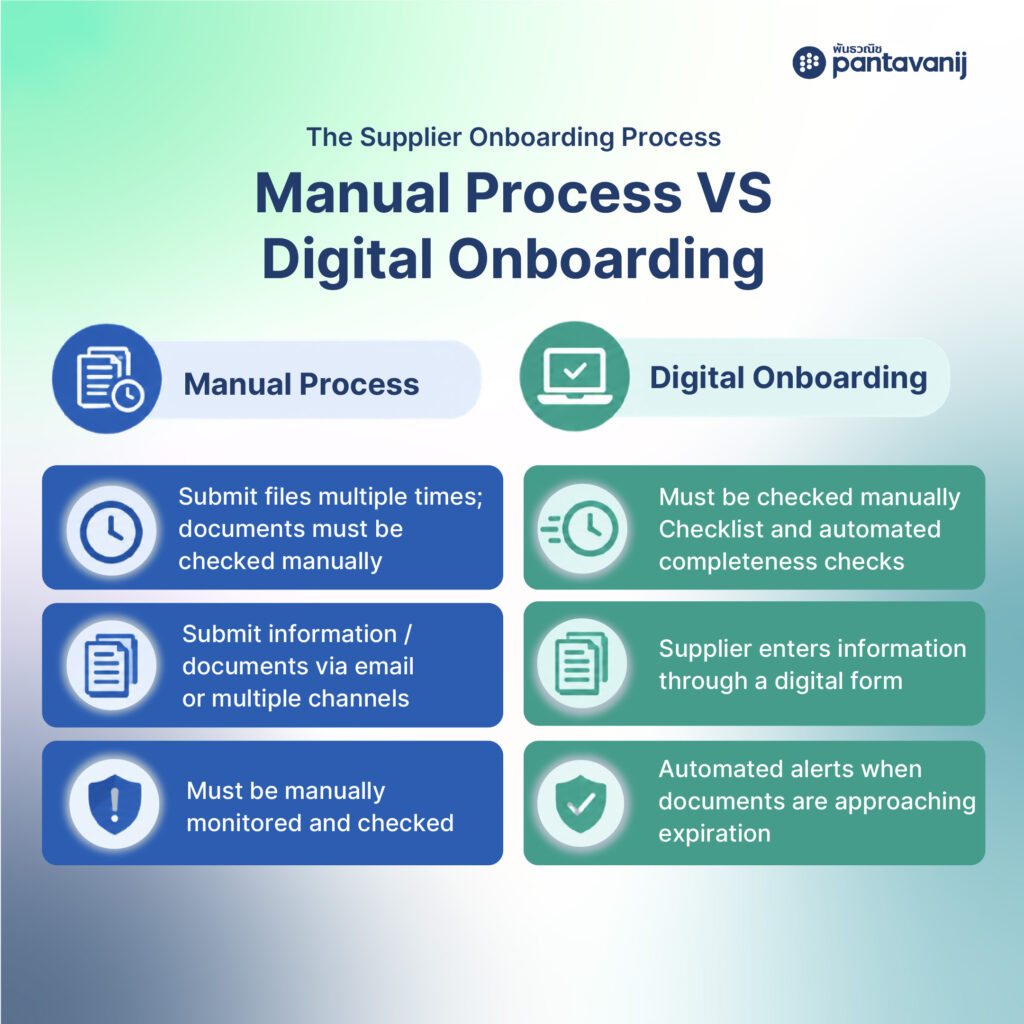
Digital onboarding systems reduce the process from weeks to just days by:
- Allowing suppliers to input data and upload documents via self-service portals
- Automatically verifying document completeness
- Alerting teams when documents like ISO certificates or business licenses near expiration
- Automatically connecting supplier data with other procurement systems
- Assigning risk tiers and surfacing them on a dashboard so procurement teams get an instant overview
How Pantavanij Supports This Journey
Supplier Connect enables a fully digital onboarding experience — suppliers can submit information and documents through a self-service portal, reducing the procurement team’s manual workload.
Supplier 360 provides a holistic view of supplier data — from onboarding to transaction history to risk assessment results — all in one place.
Book a Demo / Contact Pantavanij Sales Team
Frequently Asked Questions
Q1 : How long should supplier onboarding take?
A : With an efficient digital process, onboarding should take no more than 3-5 business days, compared to 2-4 weeks with manual processes.
Q2 : What documents are typically required for supplier onboarding?
A : Common requirements include company registration certificates, tax registration, quality certifications (e.g., ISO), and banking details, depending on organizational policy.
Q3 : Should risk screening be done for every supplier?
A : Yes — at least a basic level for all suppliers, with deeper screening for high-value transactions or high-risk categories, following supplier risk tiering principles.
Q4 : Is a self-service portal secure?
A : Yes. These systems include access controls and data verification before any information is approved into the master database.
Q5 : What is supplier risk tiering, and how does it help an organization?
A : It’s the practice of classifying suppliers by risk level based on transaction value or strategic importance, so screening depth matches actual risk — helping procurement teams focus their time where it matters most instead of over-processing low-risk suppliers.
Q6 : Which KPI should we track first when starting digital onboarding?
A : Start with onboarding cycle time and document completion rate — they’re the clearest indicators of common bottlenecks and the fastest to measure.
Q7 : Why does supplier master data matter for onboarding?
A : It’s the shared source of truth other departments — like accounting and finance — rely on. If the data is inaccurate or outdated, it affects the entire organization, not just procurement.
Efficient supplier onboarding doesn’t just save time
— it reduces risk and builds strong relationships with suppliers from day one. Adopting digital technology, tracking the right KPIs, and avoiding common mistakes is a critical step toward building a robust, trustworthy supplier network.