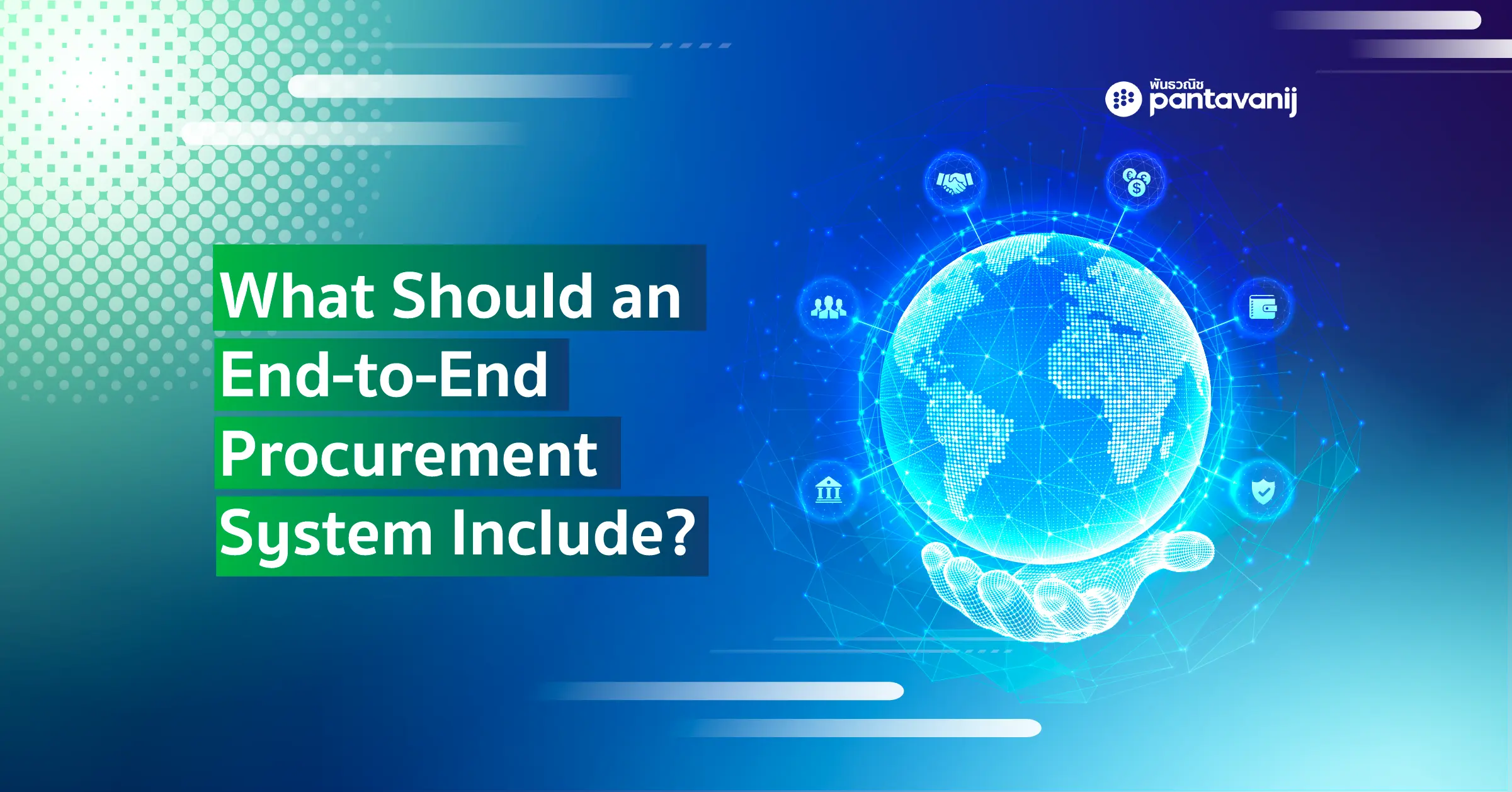
What Should an End-to-End Procurement System Include? A Deep Dive for Enterprises
In short: An end-to-end procurement system connects the entire purchasing lifecycle, from planning and spend analysis to sourcing, ordering, payment, risk management and compliance. It is built on four pillars: Strategic Planning & Analytics, Source to Contract, Procure to Pay, and Procurement Excellence. Data flows between them so each stage informs the next.
An enterprise procurement system does far more than create purchase requisitions (PR) or purchase orders (PO). It should connect the whole procurement process so organizations can operate efficiently and transparently, and make decisions based on data.
Why an Enterprise Procurement System Is More Than Ordering
When people think of a procurement system, they often picture creating requisitions, routing approvals and issuing purchase orders. But for organizations with many spend categories, a large supplier base or multi-level approvals, procurement also includes steps before and after the order that must work together.
Before an order exists, organizations need to plan budgets, analyze spend, find and evaluate suppliers, compare proposals and manage contracts. After the order, they still need to receive goods, verify invoices, pass data to an ERP or accounting system, and monitor risk and compliance.
That is why an end-to-end procurement system treats procurement as one connected process rather than isolated steps. Data from one stage can support decisions in another.
The 4 Pillars of an End-to-End Procurement System
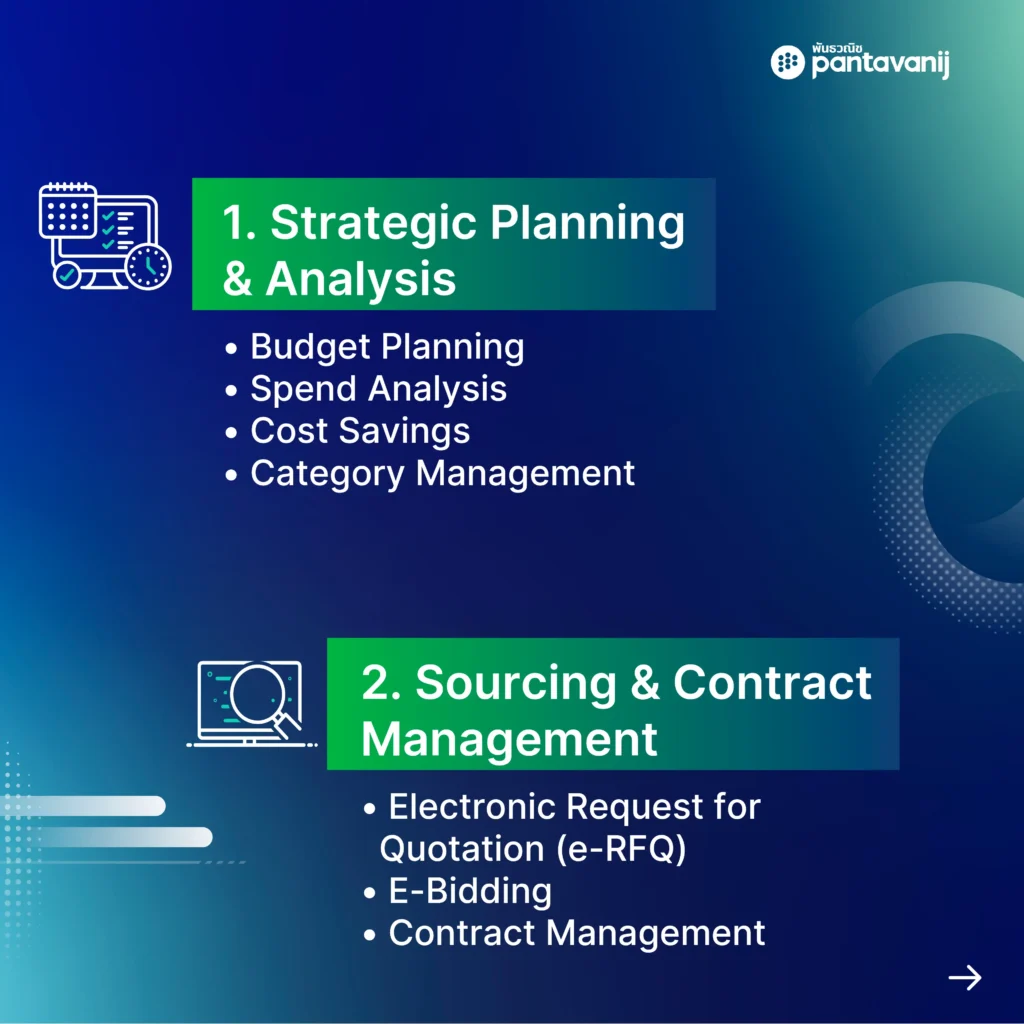
1. Strategic Planning & Analytics: Plan Before You Buy
Effective procurement starts before a purchase request is raised. Late planning pushes teams into urgent purchases, leaving less time to search, compare and negotiate with suppliers. Using budget and spend data in advance lets procurement work proactively.
Strategic Planning & Analytics includes:
- Business Alignment (Budget Planning): linking procurement plans to organizational budgets.
- Spend & Savings Analysis: understanding which goods, services and suppliers the organization spends on, and where cost opportunities exist.
- Category Management: managing purchasing by category so strategy reflects the whole picture of spend, not just individual transactions.
Together, these let procurement shift from reacting to requests to planning strategically based on real organizational data.
Key idea: Strategic procurement asks not only “what should we buy?” but “how should the organization spend?” to stay aligned with budgets and business goals.
2. Source to Contract: From Supplier Sourcing to Contract Management
Once needs and plans are clear, the next step is finding and selecting the right suppliers. This goes beyond price to include qualifications, operational capability and counterparty risk.
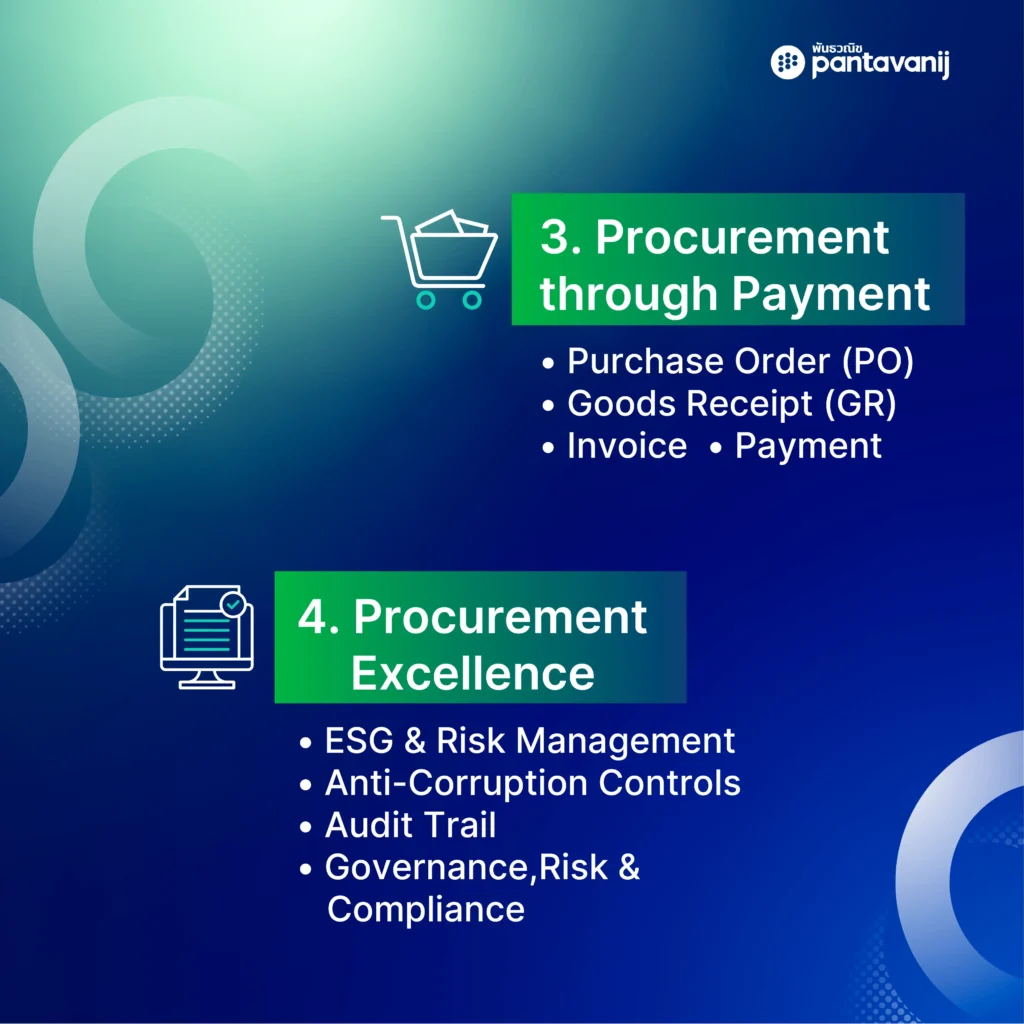
Source to Contract covers supplier sourcing, requests for information or proposals through eRFX, competitive bidding through eAuction, comparison and negotiation, and contract creation and management.
A common sourcing challenge is the time spent finding suppliers, collecting proposals, comparing prices and obtaining approvals, especially when information is scattered across emails and spreadsheets. Putting these steps on one system and reducing manual work can shorten procurement cycle time, particularly in sourcing, proposal collection and approval. Supplier management also shouldn’t end once a supplier is chosen: ongoing monitoring and evaluation help manage relationships and risk across the whole supplier lifecycle.
Pantavanij offers solutions for this stage:
- eRFX runs RFI, RFQ and RFP processes digitally. Organizations can send requests to multiple suppliers, collect proposals and compare them in one system, instead of gathering responses by email or building comparison sheets by hand.
- eAuction moves bidding and supplier competition online, making negotiation structured and transparent and cutting manual back-and-forth.
Key idea: Supplier selection isn’t just about “who offers the best price” but “who best fits the organization’s requirements and conditions.”
3. Procure to Pay (P2P): Connecting Requisition to Payment
After sourcing, the process moves into Procure to Pay, the core transactions of procurement: purchase requisition (PR), approval, purchase order (PO), goods receipt (GR), invoice verification and handoff for payment.
The heart of P2P isn’t digitizing paper documents. It is making data from each step connect and carry forward. For example, once a PR is approved, its data feeds PO creation. When the supplier delivers, goods receipt data supports invoice verification before the data is sent to the ERP or accounting system to record the payable and process payment.
This kind of data linkage reduces repeated data entry and manual errors, and makes it easier for procurement teams to track transaction status.
Key idea: Procure to Pay is not simply turning PR and PO into digital forms. It’s connecting data from requisition all the way to payment.
4. Procurement Excellence: From Buying Successfully to Buying with Governance
Good procurement isn’t measured only by how fast you buy or whether you get a fair price. It must also account for risk, transparency, policy compliance and relevant standards.
Procurement Excellence lifts procurement from managing transactions to governing the process as a whole, covering ESG & Risk Management, Supplier Lifecycle Management, Compliance & Fraud Control and Governance, Risk & Compliance (GRC).
For example, organizations may need to monitor supplier risk and detect unusual behavior or transactions. On the governance side, a procurement system should keep an audit trail of steps and decisions, so organizations can review who performed or approved each action, supporting transparency and policy-aligned audits.
Pantavanij’s Integrity One uses AI and big data to analyze purchasing behavior and detect anomalies, supporting risk management and compliance in procurement.
Key idea: Good procurement doesn’t end at “bought successfully.” It means buying transparently, to standard, with risk under control.
Why Should a Procurement System Connect Every Stage?
What matters in an end-to-end procurement system is not how many features it has, but whether data from each part can connect and be reused across the process. Planning data sets direction, sourcing data supports supplier selection, P2P data reflects actual spend, and supplier risk and compliance data let organizations look beyond price.
When connected, procurement becomes a continuous loop:
Planning → Sourcing → Contract → Purchasing → Payment → Risk & Compliance → Analytics → back to the next planning cycle
Data from each purchase doesn’t end when the transaction closes. It can be reused to track results, analyze performance and plan future purchasing, helping the organization improve continuously.
Sourcing shows this clearly. Data from eRFX and eAuction results can support comparison and supplier award approval, with an audit trail of decisions for later review. Procurement teams and executives get the information they need without collecting it from emails, documents and multiple files.
AI Intelligence Core: AI Across the Whole Procurement Lifecycle
As procurement data becomes more connected, AI can move from assisting individual tasks to acting as an intelligence layer across procurement.
The PTVN Procurement Suite places an AI Intelligence Core at the center of the platform, connecting AI to data analysis, supplier sourcing, risk management and compliance. This differs from treating AI as a standalone feature: when AI works on data from the full lifecycle, intelligence can support decisions at many points in the process.
One example is Integrity One, which uses AI to analyze purchasing behavior and detect anomalies. Pantavanij also applies AI-powered assessment of suppliers’ financial strength, operational capability and ESG risk.
The goal isn’t to have AI “replace people,” but to help procurement analyze, verify and decide more effectively using data.
From Procurement Platform to B2B eMarketplace
Once internal procurement data and processes are connected, the next step in digital procurement is extending to a wider supplier ecosystem.
Under the PTVN Procurement Suite & Product Roadmap 2026, Pantavanij is developing a B2B eMarketplace that lets organizations connect with suppliers in a broader ecosystem, extending from internal procurement management to linking buyers and suppliers on a digital ecosystem. Future procurement platforms may do more than manage internal workflows: they may also connect purchasing demand with supplier networks and related data in one place.
7 Questions to Ask Before Choosing a Procurement System
Platforms differ in scope, so don’t choose on feature count alone. Start by assessing how well a system supports your procurement lifecycle and your organization’s complexity.
- How much of the procurement lifecycle does it cover? Only PR and PO, or planning, sourcing and supplier management through payment and analytics?
- Is data connected between processes? Modules that work in isolation can leave you with manual re-entry and handoffs.
- Does it support sourcing, supplier and contract management? This matters most with many suppliers or multiple spend categories.
- Can it integrate with your ERP or accounting system? Procurement data should flow into accounting and payment.
- Does it provide analytics for decisions? It should show spend, savings and procurement performance, not just store transactions.
- Does it support risk, ESG and compliance? Large organizations need efficiency and governance together.
- How is AI used? Beyond point features, can AI support data analysis, supplier management, risk and decisions across the lifecycle?
Starting from these questions helps you choose based on business requirements and procurement strategy rather than features alone.
PTVN Procurement Suite: The Procurement Lifecycle on One Platform
PTVN Procurement Suite is a procurement platform built to support the enterprise procurement lifecycle. It is structured on four pillars (Strategic Planning & Analytics, Source to Contract, Procure to Pay and Procurement Excellence) with an AI Intelligence Core at the center.
- Procure to Pay: PR Management, Spot Buy / Direct Purchasing, PO Management, Invoice & Payment.
- Source to Contract: Smart Sourcing and Supplier Management, with Contract Management in development per the product roadmap.
- Also: the Taokae Chatbot to assist users, and a B2B eMarketplace in development to extend connections between organizations and the supplier ecosystem.
Organizations looking for more efficient, transparent and data-connected procurement can learn more about Pantavanij’s online procurement system for buyers or contact Pantavanij’s experts to book a demo.
Frequently Asked Questions
Q 1 What should an end-to-end procurement system cover?
A : It should cover planning and spend analysis, sourcing and supplier management, ordering and payment, and risk, compliance and analytics data for future planning.
Q 2 How is a procurement system different from PR and PO processing?
A : PR and PO are only part of procurement. An enterprise system should support the wider process: planning, sourcing, supplier management, procure to pay, risk and analytics.
Q 3 Why should a procurement system connect data across all stages?
A : Connected data reduces re-entry and errors, and lets information from planning, sourcing, purchasing, payment and risk inform decisions and the next planning cycle.
Q 4 What should organizations consider when choosing a procurement system?
A : Consider lifecycle coverage, ERP or accounting integration, supplier management, analytics, risk and compliance, and the ability to scale with the organization.
Q 5 How can AI be used in procurement?
A : AI can support data analysis, supplier sourcing and evaluation, anomaly detection, risk management and compliance, helping procurement teams make better data-driven decisions.