
What Is an e-Procurement System? How Is It Different from Traditional Procurement?
An online procurement system, or e-Procurement, applies digital technology to manage an organization’s procurement process, from finding and selecting suppliers, requesting quotations, raising purchase requests and approvals, and issuing purchase orders, through to receiving goods and managing invoices. It reduces manual work, increases speed and accuracy, and makes procurement data systematically trackable and auditable.
For organizations whose procurement involves multiple departments, e-Procurement connects processes and data on a single system and lets the procurement function spend more time on cost management, suppliers, and strategic planning.
What Is an Online Procurement System (e-Procurement)?
e-Procurement (Electronic Procurement) is the application of Information and Communication Technology (ICT) to the procurement process, turning steps that were once done on paper or across multiple separate systems into something managed systematically through digital systems.
The e-Procurement process can cover the entire cycle, or Source-to-Pay: finding and selecting suppliers, requesting quotations, raising purchase requests and approvals, issuing purchase orders, receiving goods, managing invoices, and passing related data on to the payment process.
The key point of an online procurement system is therefore not merely converting paper documents into digital form, but connecting the data, processes, and people involved in procurement so they can work together systematically.
How Does an Online Procurement System Work?
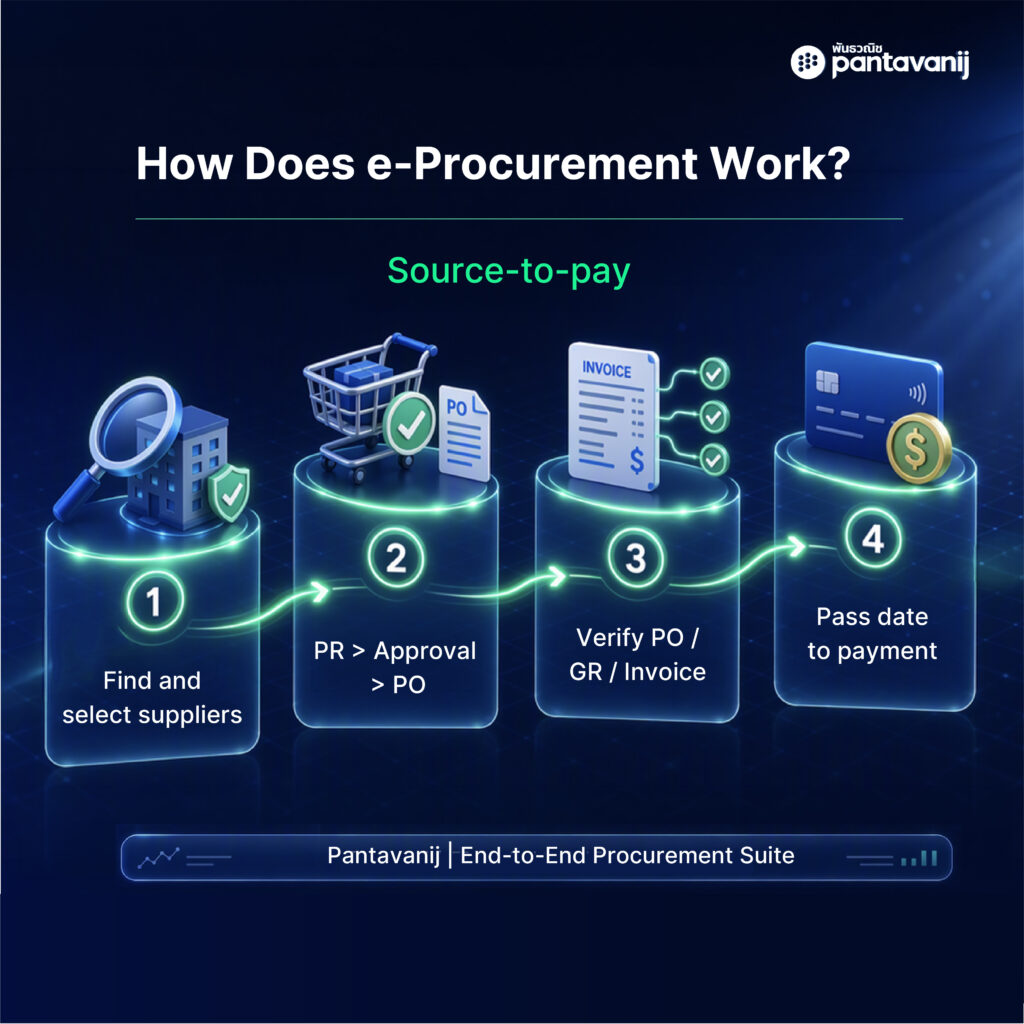
The process can cover everything from supplier discovery through to post-purchase steps. Each organization may have a different workflow and different details depending on its procurement policy.
1. e-Sourcing: Finding and selecting suppliers
Starting from supplier discovery, organizations can request information or quotations from suppliers that have been verified through Pantavanij’s Supplier 360 (Supplier Due Diligence). They can then compare prices and terms, so the organization has suitable information for selecting suppliers that match its needs.
2. e-Purchasing: Requesting, approving, and issuing purchase orders
Users can create a Purchase Request (PR) and submit it into the approval process according to the organization’s workflow. Once approved, a Purchase Order (PO) is issued and the data is sent to the supplier automatically, with notification by email.
3. e-Invoicing: Managing and verifying invoices
The system helps manage invoice data and links it with purchase order and goods receipt data, making the verification of procurement-related documents more systematic, while also reducing omissions that cause lost sales opportunities.
4. Payment Process: Passing data to payment
After the data and related documents have been verified, the data can be passed on to the organization’s payment process and stored for tracking and analyzing future procurement.
How Is an Online Procurement System Different from Traditional Procurement?
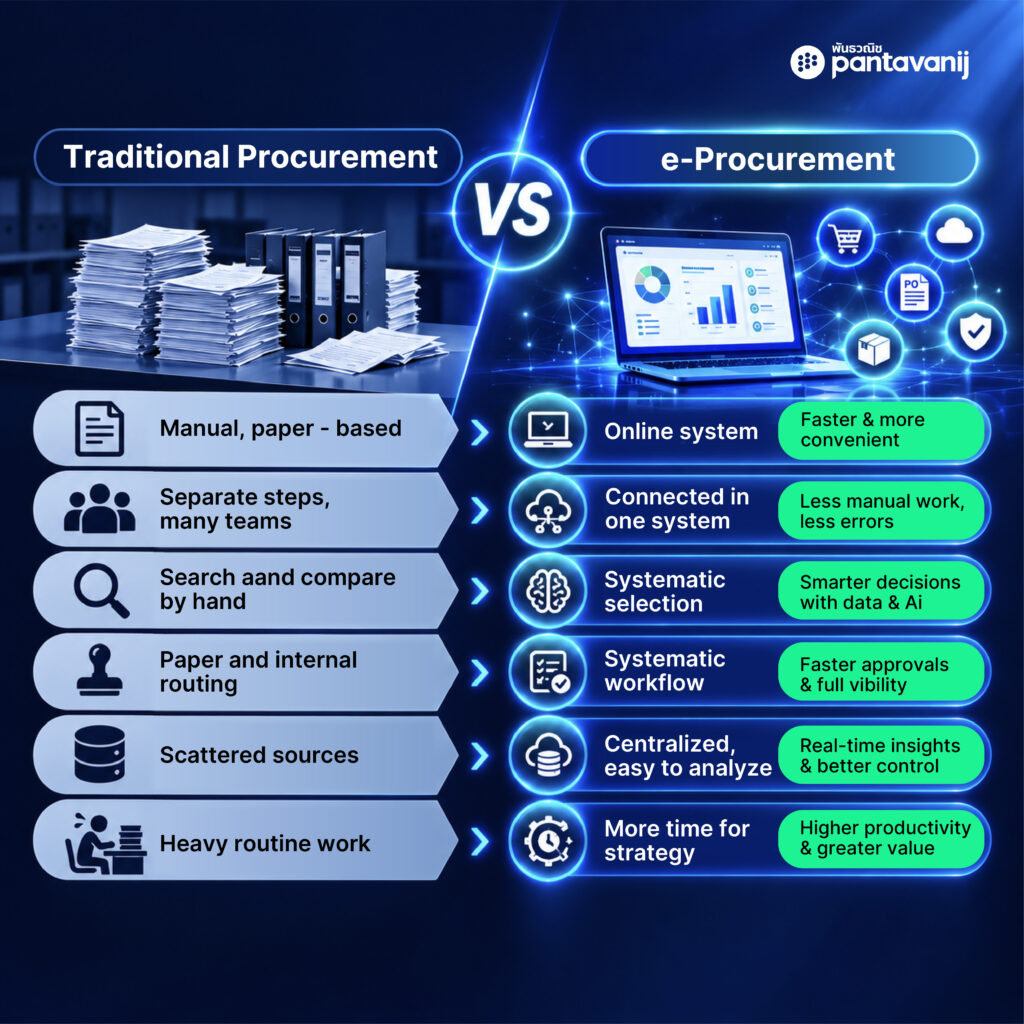
The key difference between traditional procurement and e-Procurement lies in how processes and data are managed. An online procurement system links the various steps through a digital system, instead of relying mainly on paper documents and manual coordination.
| Traditional Procurement | e-Procurement | |
|---|---|---|
| Way of working | Mainly manual and paper-based | Procurement runs through an online system |
| Procurement process | Each step may be separate and requires coordination across many parties | Procurement steps are connected in a single system |
| Supplier search | Search for, contact, and compare vendors by oneself | Helps gather information to search, compare, and select quality suppliers systematically |
| Approval | Handled through documents and internal procedures | Requested and approved through a workflow on the system |
| Procurement data | Data may be scattered across documents or multiple sources | Data is consolidated in the system, making it easier to track and analyze |
| Role of the procurement team | Spends a lot of time on paperwork and routine tasks | Less redundant work, leaving more time for strategic planning |
What Are the Benefits of an Online Procurement System for Organizations?
An e-Procurement system does more than turn the procurement process digital. It also helps organizations manage time, cost, suppliers, and procurement data more systematically. The key benefits are as follows.
Reduce procurement cycle time by up to 70%
An e-Procurement system reduces manual work and connects steps such as purchase requests, approvals, and purchase orders within a clear workflow, making it easier for the procurement team to track status and get work done. According to Pantavanij, the solution can reduce processing time by up to 70%.
Reduce procurement costs by approximately 15–25%
Consolidating procurement data in the system lets organizations see spending, purchase history, and related data systematically, which can be used for budget planning and to identify opportunities for cost management. Pantavanij states that its buyer solution can help reduce procurement costs by approximately 15–25%.
Increase transparency and enable 100% retrospective auditing
Recording procurement data and steps digitally makes it easier for organizations to track status and audit data retrospectively, such as work steps, approvals, and the data used to support purchasing. This supports Procurement Transparency and the governance of the organization’s procurement process.
Reduce errors from paperwork
Reducing the recording and passing on of data by paper, or repeated work across multiple steps, lowers the chance of data-entry errors, use of different document versions, or data scattered across multiple sources.
Improve supplier management efficiency
When supplier data and procurement data are stored systematically, the Procurement and Sourcing teams can search, compare, and track supplier-related information more conveniently to support procurement decisions.
Use data to help plan procurement
Data from the procurement process, such as purchase history, suppliers, and spending, can be analyzed to identify trends, plan budgets, and support future Procurement decisions.
How to Choose an Online Procurement System That Fits Your Organization
Choosing an online procurement system (e-Procurement) should not stop at asking whether the system can move procurement steps from paper to online. Consider whether the system can comprehensively support your organization’s procurement process, connect data between steps, and help the procurement team work efficiently over the long term.
Organizations can evaluate an e-Procurement system on the following key factors.
1. Covers the procurement process end-to-end
The system should support the key procurement processes from sourcing and selecting suppliers, purchase requests, approvals, and purchase orders through to post-order steps, to reduce the need to work across multiple separate systems.
2. Supports your organization’s workflow and approval steps
Each organization has a different approval structure and procurement policy, so the chosen system should support a workflow that fits real working processes, so that purchase requests and approvals are systematic and auditable.
3. Supports systematic supplier data management
The system should help the organization store and manage supplier data related to procurement systematically, so that the Procurement and Sourcing teams can search, compare, track, and use the data to make decisions more easily.
4. Provides data for tracking and analyzing procurement
In addition to supporting day-to-day operations, the system should give the organization visibility into relevant data such as purchase history, supplier data, and spending, to support future planning and cost management.
5. Supports enterprise-level use and future growth
Organizations should consider whether the system can handle growth in the number of users, suppliers, transaction volume, and process complexity, as well as its ability to connect with other systems the organization already uses.
EP One: End-to-End Online Procurement from Pantavanij — How Does It Help Organizations?
EP One from Pantavanij is an End-to-End Enterprise Procurement Suite designed to connect procurement processes and data on a single platform, in order to improve procurement management efficiency, reduce work steps, and make related data systematically trackable.
According to Pantavanij, the system covers the key procurement processes, together with capabilities that support the work, such as Smart eCatalog for selecting products, Workflow Builder for designing work and approval steps, and eInvoice Matching for verifying data across Purchase Order (PO), Goods Receipt (GR), and Invoice.
In addition, consolidating procurement data on a single platform helps organizations track budget and cost data, increase process transparency, and use the data more easily for procurement planning.
For details about the functions and how to implement the system in your organization, learn more at Pantavanij’s e-Procurement system.
Summary: How Does an Online Procurement System Help Organizations Manage Procurement?
An online procurement system (e-Procurement) connects the procurement process, from finding and selecting suppliers, purchase requests and approvals, and issuing purchase orders, to receiving goods and managing invoices, through digital systems. It reduces manual work, increases speed and accuracy, and makes procurement data easier to track, audit, and use for planning.
Especially for organizations with many procurement steps, many suppliers, or many parties involved in approvals, choosing an e-Procurement system that supports end-to-end processes and adapts to the organization’s workflow will help the Procurement and Sourcing teams manage their work more systematically.
For organizations that want to explore adopting an online procurement system, you can review the details of Pantavanij’s e-Procurement, or consult our team of experts to assess which type of system suits your organization’s procurement process.
Frequently Asked Questions About Online Procurement Systems
Q 1 What is an online procurement system (e-Procurement)?
A : An online procurement system, or e-Procurement, is the use of digital technology to manage the procurement process, from finding suppliers, purchase requests and approvals, and issuing purchase orders, to receiving goods and managing invoices. It connects procurement steps and data so they can be managed systematically through the system.
Q 2 What steps does an e-Procurement system include?
A : In general, e-Procurement can cover finding and selecting suppliers (e-Sourcing), purchase requests and purchase orders (e-Purchasing), goods receipt (Goods Receipt), invoice management (e-Invoicing), and passing data on to the payment process.
Q 3 How is e-Procurement different from traditional procurement?
A : Traditional procurement often relies on paper and manual coordination at many steps, whereas e-Procurement connects processes and data through digital systems, making it easier to track status, audit data retrospectively, and analyze procurement data.
Q 4 What are the benefits of an online procurement system?
A : An online procurement system reduces steps and manual work, speeds up operations, helps control costs and budgets, increases transparency, reduces errors from paperwork, and allows supplier and procurement data to be used systematically for planning and decision-making.
Q 5 What kind of organization is an online procurement system suitable for?
A : e-Procurement suits organizations that want to manage procurement systematically, especially those with high purchasing volume, many suppliers, multi-level approval steps, or a need to consolidate procurement data for easier tracking, auditing, and analysis.
Q 6 Can e-Procurement connect with ERP?
A : Some e-Procurement systems can connect or exchange data with ERP systems, so that data from the procurement process can be used further in accounting, finance, or enterprise management.