
What Is an RFP? How It Differs from RFI and RFQ, and Which to Use in Procurement
RFI, RFP and RFQ are the types of requests that procurement teams use to gather information from suppliers at each stage of sourcing. An RFI (Request for Information) is used to collect preliminary information. An RFP (Request for Proposal) is used to request proposals that can be compared across multiple factors. An RFQ (Request for Quotation) is used to request price quotes once the requirements or specifications are clear. Understanding the differences between these three formats helps procurement teams choose the right one for their objectives and compare suppliers more systematically.
What Are RFI, RFP and RFQ?
Although RFI, RFP and RFQ are all tools for communicating with suppliers and collecting information from them, the information an organization needs from each format is different. The choice should be based on how clear the requirements are and what information the procurement team needs to support its decision.
What Is an RFI?
An RFI (Request for Information) is a request for preliminary information from suppliers. It helps an organization understand the market, the products or services available, and suppliers’ capabilities before moving on to a more detailed selection process.
An RFI suits the stage where procurement is still exploring the market: which suppliers could meet the need, what kinds of products or services are available, and what each supplier is capable of. The information gathered can help define requirements or shortlist suppliers before moving on to an RFP or RFQ, where necessary.
What Is an RFP?
An RFP (Request for Proposal) is a request for proposals from suppliers so that an organization can assess how each one would meet its needs through its own approach or solution.
An RFP does not look at price alone. It can also be used to compare other factors, such as the working approach, technical capability, experience, timeline, terms and conditions, and price. This makes it well suited to services or complex projects where proposals need to be evaluated from several angles before a decision is made.
What Is an RFQ?
An RFQ (Request for Quotation) is a request for price quotes from suppliers. It fits when an organization already knows fairly clearly what products, services or requirements it needs, and wants to compare prices and terms from multiple suppliers.
An RFQ should therefore spell out the necessary details, such as items and quantities, specifications, scope of work, delivery timeline and any related conditions, so that suppliers quote against the same requirements and the results can be compared fairly.
How Do RFI, RFP and RFQ Differ?
| Comparison | RFI | RFP |
RFQ |
| Purpose | Request preliminary information | Request proposals or approaches | Request price quotations |
| Information requested | Supplier, product and service information, and capabilities | Working approach, proposal details and price | Price and quotation terms |
| Best used when | Exploring the market or information is still insufficient | Proposals must be evaluated on multiple factors | Requirements or specifications are fairly clear |
| Main evaluation factors | Capability and preliminary suitability | Proposal quality, capability, terms and price | Price and terms |
| Example | Surveying suppliers for a new project | Selecting a provider for a complex project | Comparing prices for goods or services with defined details |
In short: use an RFI when you want information from suppliers, an RFP when you want to compare proposals, and an RFQ when you want to compare prices.
When Should You Use an RFI, RFP or RFQ?
The choice depends on how much an organization already knows about its needs and its suppliers, and what additional information it needs to make a decision.
- Use an RFI when: you are still exploring the market, looking for suppliers, or learning what products, services and solutions could meet the organization’s needs.
- Use an RFP when: you have a problem or goal but want suppliers to propose how txhey would address it, and you need to evaluate proposals on multiple factors, not just price.
- Use an RFQ when: requirements or specifications are already clear and you want to compare prices and terms from multiple suppliers.
Note that you do not need to use all three formats in every purchase. Procurement teams can choose the format that suits the type of product or service, its complexity, and the information needed to make a decision.
RFI, RFP และ RFQ เป็นส่วนหนึ่งของกระบวนการสรรหาผู้ขาย ที่ช่วยให้ฝ่ายจัดซื้อรวบรวมข้อมูล ประเมินข้อเสนอ และคัดเลือก Supplier โดยกระบวนการสามารถสรุปได้เป็น:
Where Do RFI, RFP and RFQ Fit in the Sourcing Process?
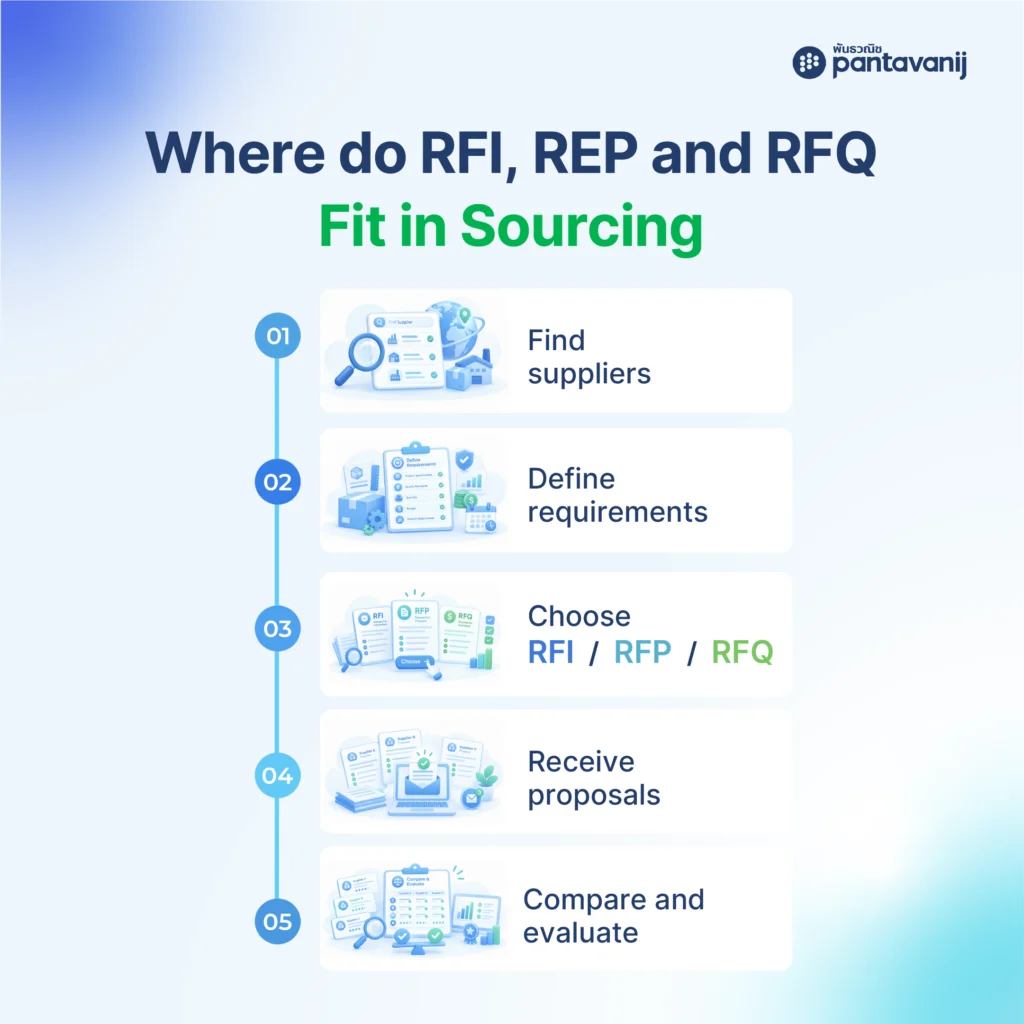
RFI, RFP and RFQ are part of the supplier sourcing process, helping procurement teams collect information, evaluate proposals and select suppliers. The process can be summarized as follows:
- Find potential suppliers. Explore and identify suppliers that can meet the organization’s product, service or project needs.
- Define requirements and the information needed. Specify the products, services, scope or questions that will be used to evaluate suppliers.
- Choose an RFI, RFP or RFQ. Pick the request type that fits the objective: an RFI to gather information, an RFP to receive proposals, or an RFQ to request prices.
- Receive information or proposals from suppliers. Suppliers submit information, proposals or quotations according to the details the organization specified.
- Compare and evaluate suppliers. Compare each supplier’s information against the defined criteria.
- Select a supplier. Choose the supplier that best fits the requirements and the terms of the sourcing.
What Is eRFX? From RFI, RFP and RFQ to Online Sourcing
eRFX is an online supplier sourcing system from Pantavanij. The “X” stands for the various types of requests used in procurement and sourcing. The system supports the process from finding business partners and creating requests to receiving information or proposals and comparing data to help select the right supplier.
🔗 Read more: How the eRFX online supplier sourcing system helps procurement
How Does eRFX Make Supplier Sourcing and Selection Easier?
One of the key components of eRFX is the Supplier Directory, which helps procurement teams find new suppliers from a central database. It includes more than 30,000 suppliers verified against data from the Revenue Department and the Department of Business Development, covering more than 31 product and service categories under the UNSPSC standard.
The process on the platform runs from Supplier Directory → Questionnaire Creation → eRFx Creation → eRFx Submission → Price Summary → Supplier Award, helping procurement teams manage supplier information and proposals at every step more systematically.
Once suppliers submit their information or proposals, procurement teams can compare the data and prices to support their evaluation and select suppliers according to the requirements of each sourcing event.
🔗 Learn more about the eRFX online supplier sourcing system from Pantavanij
Summary: Choosing RFI, RFP and RFQ to Fit Your Procurement Process
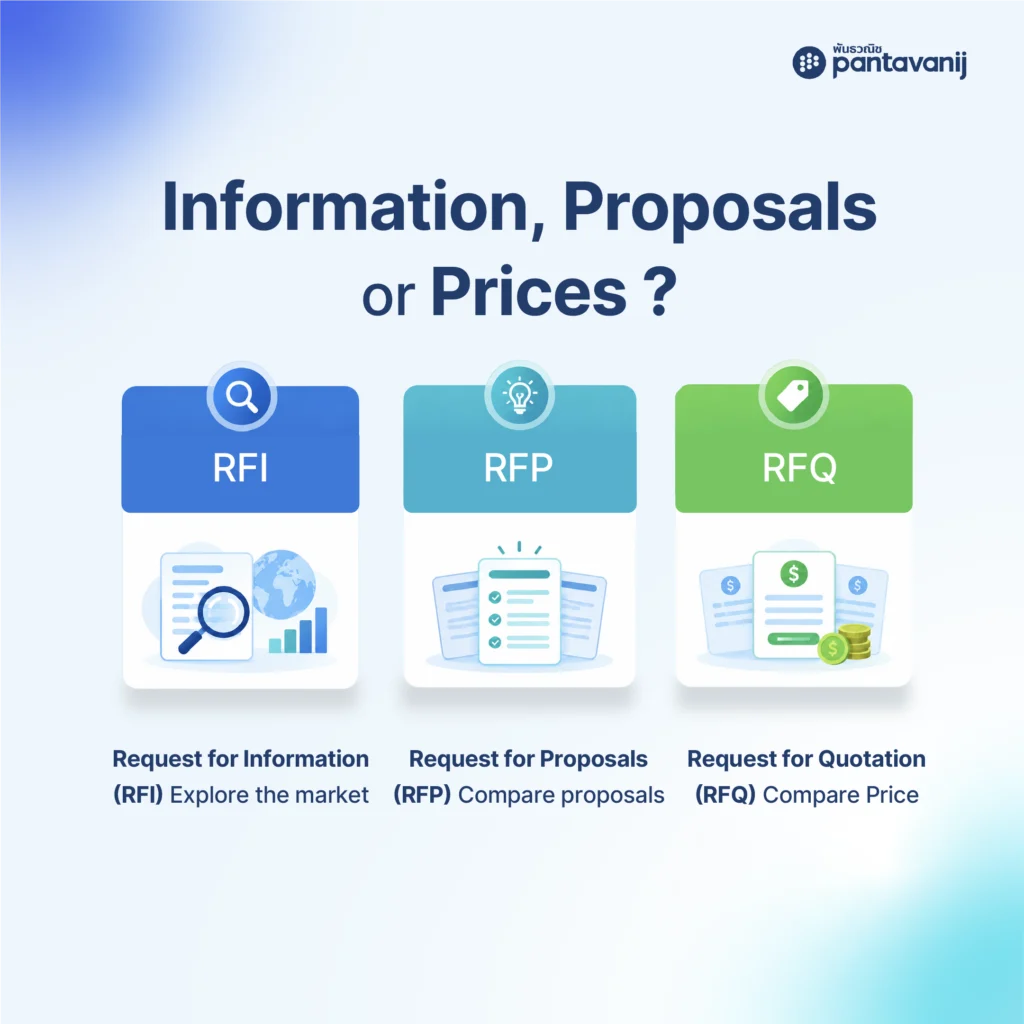
The key to choosing among RFI, RFP and RFQ is to ask whether procurement needs “information, proposals or prices” from suppliers. If you want to explore the market and gather preliminary information, choose an RFI. If you want to compare proposals and approaches, choose an RFP. If requirements are clear and you want to compare prices, choose an RFQ. Matching the format to the objective helps procurement teams collect and compare supplier information more systematically.
Frequently Asked Questions About RFI, RFP and RFQ
Q1 : How do RFI, RFP and RFQ differ?
A : An RFI requests preliminary information from suppliers to survey the market and understand their capabilities. An RFP requests proposals and approaches for meeting the organization’s needs. An RFQ requests price quotations once the requirements or specifications are clear.
Q2 : Should I choose an RFP or an RFQ?
A : Choose an RFP when you want to evaluate proposals on several aspects, such as working approach, capability, terms and price. An RFQ fits when you already know the details of the product or service you need and want to compare prices and terms from multiple suppliers.
Q3 : Do I need to issue an RFI before every RFP or RFQ?
A : No. The choice depends on your needs and the information you already have. If you already know your requirements and the suppliers you want to approach, you can go straight to an RFP or RFQ without starting with an RFI.
Q4 : What should an RFP include?
A : An RFP should state the project details and objectives, the scope or requirements, the criteria for evaluating proposals, the project timeline and any related terms, so that suppliers can prepare proposals that match the organization’s needs.
Q5 : How does eRFX relate to RFI, RFP and RFQ?
A : eRFX brings requests such as RFI, RFP and RFQ into a digital system. It lets procurement teams send requests, receive information or proposals from suppliers, and compare the data to support supplier selection more systematically.